Eleven post in one month. Woo hoo! No wonder I've got a headache.
Tuesday, 27 November 2012
The search for Sandy Island continues
Recently, it was discovered (or undiscovered) that an island that had been included on maps for years did not exist. The story broke recently and even made it onto the BBC web site, and since then people have been trying to track down the history of this fictional island.
The blog at Auckland Museum has a chart that places its discovery in 1876 to a ship called Velocity, but the blog notes that the map came with a disclaimer warning readers of the accuracy of the positions of low-lying islands in that part of the ocean.
As a member of the army or armchair experts created by the internet, I set off on a voyage of discovery to find traces of this island for myself. It didn't take long to realise I was already walking in other people's footsteps as I found little new on the subject. I did, however, find on Google Books a volume dated 1851 that listed Sandy Island (New Caledonia) in its index.
So I was all excited that I'd found something that everyone else had missed, until I looked at the entry in closer detail. Unfortunately, this refers to a smaller Sandy Island which is much nearer the coast of New Caledonia and does, to my knowledge, really exist.
But, anyway, this is a beautiful story and it's a useful reminder that however important and established an authority may be on a subject, it doesn't hurt to check the basics.
Perhaps the fake Sandy Island kept itself in reference books simply by being in a place where no one would check, and by having a name identical to another island not so far away. You know, when I was growing up in Hertfordshire, I would sometimes see signs to a village called Ireland. I wished I'd checked if it was really there, and not some cartographer's quirk.
The blog at Auckland Museum has a chart that places its discovery in 1876 to a ship called Velocity, but the blog notes that the map came with a disclaimer warning readers of the accuracy of the positions of low-lying islands in that part of the ocean.
As a member of the army or armchair experts created by the internet, I set off on a voyage of discovery to find traces of this island for myself. It didn't take long to realise I was already walking in other people's footsteps as I found little new on the subject. I did, however, find on Google Books a volume dated 1851 that listed Sandy Island (New Caledonia) in its index.
So I was all excited that I'd found something that everyone else had missed, until I looked at the entry in closer detail. Unfortunately, this refers to a smaller Sandy Island which is much nearer the coast of New Caledonia and does, to my knowledge, really exist.
But, anyway, this is a beautiful story and it's a useful reminder that however important and established an authority may be on a subject, it doesn't hurt to check the basics.
Perhaps the fake Sandy Island kept itself in reference books simply by being in a place where no one would check, and by having a name identical to another island not so far away. You know, when I was growing up in Hertfordshire, I would sometimes see signs to a village called Ireland. I wished I'd checked if it was really there, and not some cartographer's quirk.
Saturday, 24 November 2012
Psychic Archaeology in Egypt
Leading on from my post about psychics and archaeology, I now turn to an example where the psychics' knowledge of the subject in question is so limited that it can't be considered a potential source of information.
In 1978 Stephan Schwartz arranged for some remote viewers to concentrate on the bay of Alexandria, before sending a team of divers along to check their findings. The bay was chosen because, despite it's obvious importance in the history of Egypt, it had not been extensively investigated by archaeologists.
At first the remote viewers were sent a map of the area (with names and identifiers removed) and asked to indicate locations relating to history. The example they give in the paper concerns questions about Cleopatra, which makes me wonder why they removed the names and identifiers from the map if they're going to include such overt references to Egypt. It appears that the remote viewers are unaware of the nature of the search, since most of the locations marked are on dry land.
After this, two remote viewers were also taken to Egypt in order that more accurate viewings could be carried out. And lastly, a new set of remote viewing was done with all viewers using maps as before. It's worth noting that between the first and second map sessions, some fieldwork was completed (in the Spring of 1979).
In the paper, A Preliminary Survey Of The Eastern Harbor, Alexandria, Egypt Including a Comparison of Side Scan Sonar and Remote Viewing, the abstract explains the aims of the experiment: "The location of the ancientshore line; the location and predictive description of several sites including: the island ofAntirrhodus and the Emporium/Poseidium/Timonium complex; a palace complex associatedwith Cleopatra; and, a further elaboration, both in terms of location and predictive description, ofthe Pharos lighthouse area." And it goes on to conclude that:
"This paper describes the probable location of the Emporium, the Poseidium, and the Timonium, the palace complex of Cleopatra, the island of Antirrhodus, a site at the tip of Fort Sisila (known previously as Point Lochias), new discoveries pertaining to the lighthouse, and an associated temple. The most important discovery though is the identification and location of the ancient seawall which extends some 65 meters further out into the harbor than was previously suspected, and whose location resolves a key piece in the puzzle of the ancient city’s layout. The discoveries reported were principally the result of Remote Viewing."
Because the area has been much more thoroughly examined since the paper was written in 1980, I thought I'd take a look to see how well their conclusions stood up to subsequent research.
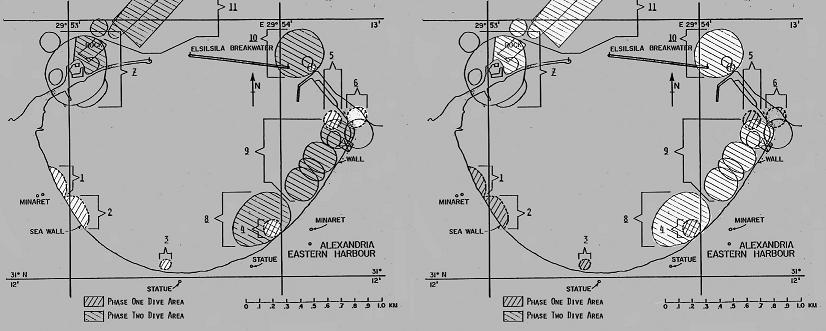
With regards to the location of the Timonium and the island of Antirrhodus, a site of a palace connected to Cleopatra, and the Poseidium the results aren't good. Overlaying Schwartz's map with a more recent one detailing the findings, one can see that the targets fall outside the areas indicated by the remote viewers (site 8). Another remote viewer placed Cleopatra's palace in site 9, which ran along the eastern shore of the harbour. Below two maps from Schwartz's paper and another archaeological site are overlaid. (It should be noted that a little adjusting needed to be done to make the harbour outlines in the two maps coincide.)
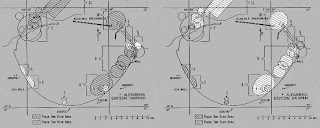
It could be said that some of the areas chosen were very close to the eventual findings, but it is probably useful at this point to compare the areas chosen in session one with session two (see below, areas highlighted). After the initial results from the first dive in area 4, the main attention seems to have switched over to that side of the Eastern Harbour, and the areas are much larger in size.
Perhaps the one success was the ancient sea wall, but that was found in a circular area that went from the modern sea wall into the bay by about 120 metres. In the paper's abstract, Schwartz says that "the ancient seawall which extends some 65 meters further out into the harbor than was previously suspected" but does not give any reference for previous estimates of the position of the seawall.
Comparing the reports of subsequent underwater archaeology from the Eastern Harbour, I have grave doubts about Schwartz's assertion that they had found "the location of [...] the Emporium and the Timonium, Mark Antony’s palace in Alexandria, the Ptolemaic Palace Complex of Cleopatra" (Schwartz's own website, Nov 2012). Other data from the paper remain difficult to judge, since I've not been able to find any further papers on those topics.
The success of remote viewing as a tool of archaeology can perhaps best be illustrated by returning to the initial areas marked out by the remote viewers when they had the least amount of information about the targets. You can see many places circled on land and, of the four areas marked in the Eastern Harbour, only one returned any decent results.
References
Schwartz, S. "A Preliminary Survey Of The Eastern Harbor, Alexandria, Egypt Including A Comparison Of Side Scan Sonar And Remote Viewing"
http://www.stephanaschwartz.com/biography/
http://weekly.ahram.org.eg/1998/402/travel.htm
Jean-Daniel Stanley, "Submergence and burial of ancient coastal sites on the subsiding Nile delta margin, Egypt",
Méditerranée [En ligne], 104 | 2005, mis en ligne le 02 février 2009, consulté le 10 octobre 2012. URL : http://
mediterranee.revues.org/2282
http://www.smithsonianmag.com/science-nature/Raising-Alexandria.html
http://web.archive.org/web/20010306200145/http://www.hol.gr/mirrors/hec/alexandria/cea/cea1.htm
In 1978 Stephan Schwartz arranged for some remote viewers to concentrate on the bay of Alexandria, before sending a team of divers along to check their findings. The bay was chosen because, despite it's obvious importance in the history of Egypt, it had not been extensively investigated by archaeologists.
At first the remote viewers were sent a map of the area (with names and identifiers removed) and asked to indicate locations relating to history. The example they give in the paper concerns questions about Cleopatra, which makes me wonder why they removed the names and identifiers from the map if they're going to include such overt references to Egypt. It appears that the remote viewers are unaware of the nature of the search, since most of the locations marked are on dry land.
After this, two remote viewers were also taken to Egypt in order that more accurate viewings could be carried out. And lastly, a new set of remote viewing was done with all viewers using maps as before. It's worth noting that between the first and second map sessions, some fieldwork was completed (in the Spring of 1979).
In the paper, A Preliminary Survey Of The Eastern Harbor, Alexandria, Egypt Including a Comparison of Side Scan Sonar and Remote Viewing, the abstract explains the aims of the experiment: "The location of the ancientshore line; the location and predictive description of several sites including: the island ofAntirrhodus and the Emporium/Poseidium/Timonium complex; a palace complex associatedwith Cleopatra; and, a further elaboration, both in terms of location and predictive description, ofthe Pharos lighthouse area." And it goes on to conclude that:
"This paper describes the probable location of the Emporium, the Poseidium, and the Timonium, the palace complex of Cleopatra, the island of Antirrhodus, a site at the tip of Fort Sisila (known previously as Point Lochias), new discoveries pertaining to the lighthouse, and an associated temple. The most important discovery though is the identification and location of the ancient seawall which extends some 65 meters further out into the harbor than was previously suspected, and whose location resolves a key piece in the puzzle of the ancient city’s layout. The discoveries reported were principally the result of Remote Viewing."
Because the area has been much more thoroughly examined since the paper was written in 1980, I thought I'd take a look to see how well their conclusions stood up to subsequent research.
With regards to the location of the Timonium and the island of Antirrhodus, a site of a palace connected to Cleopatra, and the Poseidium the results aren't good. Overlaying Schwartz's map with a more recent one detailing the findings, one can see that the targets fall outside the areas indicated by the remote viewers (site 8). Another remote viewer placed Cleopatra's palace in site 9, which ran along the eastern shore of the harbour. Below two maps from Schwartz's paper and another archaeological site are overlaid. (It should be noted that a little adjusting needed to be done to make the harbour outlines in the two maps coincide.)
![]() |
| Remote viewing results overlaid with later archaeological findings |
It could be said that some of the areas chosen were very close to the eventual findings, but it is probably useful at this point to compare the areas chosen in session one with session two (see below, areas highlighted). After the initial results from the first dive in area 4, the main attention seems to have switched over to that side of the Eastern Harbour, and the areas are much larger in size.
| Session one, left. Session two, right. |
Perhaps the one success was the ancient sea wall, but that was found in a circular area that went from the modern sea wall into the bay by about 120 metres. In the paper's abstract, Schwartz says that "the ancient seawall which extends some 65 meters further out into the harbor than was previously suspected" but does not give any reference for previous estimates of the position of the seawall.
Comparing the reports of subsequent underwater archaeology from the Eastern Harbour, I have grave doubts about Schwartz's assertion that they had found "the location of [...] the Emporium and the Timonium, Mark Antony’s palace in Alexandria, the Ptolemaic Palace Complex of Cleopatra" (Schwartz's own website, Nov 2012). Other data from the paper remain difficult to judge, since I've not been able to find any further papers on those topics.
The success of remote viewing as a tool of archaeology can perhaps best be illustrated by returning to the initial areas marked out by the remote viewers when they had the least amount of information about the targets. You can see many places circled on land and, of the four areas marked in the Eastern Harbour, only one returned any decent results.
References
Schwartz, S. "A Preliminary Survey Of The Eastern Harbor, Alexandria, Egypt Including A Comparison Of Side Scan Sonar And Remote Viewing"
http://www.stephanaschwartz.com/biography/
http://weekly.ahram.org.eg/1998/402/travel.htm
Jean-Daniel Stanley, "Submergence and burial of ancient coastal sites on the subsiding Nile delta margin, Egypt",
Méditerranée [En ligne], 104 | 2005, mis en ligne le 02 février 2009, consulté le 10 octobre 2012. URL : http://
mediterranee.revues.org/2282
http://www.smithsonianmag.com/science-nature/Raising-Alexandria.html
http://web.archive.org/web/20010306200145/http://www.hol.gr/mirrors/hec/alexandria/cea/cea1.htm
Wednesday, 21 November 2012
No Wedding for the Dead
I've been writing a lot about Spiritualism recently, since I find these reports fascinating. Whenever possible, I try to avoid second or third hand reports written decades after the event, and stick to contemporary writings.
Nevertheless, I'm aware that I have to read any newspaper articles with half an eye on a journalist's desire to please his audience/make a good story. For example, I've seen the following story in several papers (and in a few websites too, proving that you can't keep a good story down).
The story, titled “Most Shocking Affair in Bordentown” (or in other papers recounting the same story “Married With A Corpse”) describes a Spiritualist ceremony in which a woman is wed to her recently deceased fiancée. The story explains how the young lady “acted at the grave like one really possessed with an evil spirit; she raved and flung herself into the grave and was with difficulty borne from the spot to the residence of the madman whom she regards as her father-in-law.” It adds that at the dinner afterwards, a place was set at the table for him.
However, a couple of months later, a letter appeared in the Daily News explaining that the event was entirely fictional. While there had been a deceased young man and a bereaved fiancée, there was no marriage, no boy medium, no raving and no meal. Just a simple funeral service. And it was a bit of luck that I found this article, since no other newspaper published anything like a retraction of the original story that I can find.
As the letter-writer, John Jones, says “it is a sad pity that the astounding phenomena of spirit manifestations, so general in America and not scarce in England, cannot be opposed by a keener weapon than that of "false witness against thy neighbour".” As it is, I am often doubtful of some of the more colourful descriptions of Spiritualist meetings published in newspapers of the day.
References
“Most Shocking Affair in Bordentown”, New York Times, August 9, 1856
“Married with a corpse”, Lloyd's Weekly Newspaper (London, England), Sunday, August 31, 1856
“Spiritualsim: to the editor of the Daily News”, Daily News (London, England), Tuesday, September 2, 1856
Nevertheless, I'm aware that I have to read any newspaper articles with half an eye on a journalist's desire to please his audience/make a good story. For example, I've seen the following story in several papers (and in a few websites too, proving that you can't keep a good story down).
The story, titled “Most Shocking Affair in Bordentown” (or in other papers recounting the same story “Married With A Corpse”) describes a Spiritualist ceremony in which a woman is wed to her recently deceased fiancée. The story explains how the young lady “acted at the grave like one really possessed with an evil spirit; she raved and flung herself into the grave and was with difficulty borne from the spot to the residence of the madman whom she regards as her father-in-law.” It adds that at the dinner afterwards, a place was set at the table for him.
However, a couple of months later, a letter appeared in the Daily News explaining that the event was entirely fictional. While there had been a deceased young man and a bereaved fiancée, there was no marriage, no boy medium, no raving and no meal. Just a simple funeral service. And it was a bit of luck that I found this article, since no other newspaper published anything like a retraction of the original story that I can find.
As the letter-writer, John Jones, says “it is a sad pity that the astounding phenomena of spirit manifestations, so general in America and not scarce in England, cannot be opposed by a keener weapon than that of "false witness against thy neighbour".” As it is, I am often doubtful of some of the more colourful descriptions of Spiritualist meetings published in newspapers of the day.
References
“Most Shocking Affair in Bordentown”, New York Times, August 9, 1856
“Married with a corpse”, Lloyd's Weekly Newspaper (London, England), Sunday, August 31, 1856
“Spiritualsim: to the editor of the Daily News”, Daily News (London, England), Tuesday, September 2, 1856
Monday, 19 November 2012
Life drawing 19/11/2012
The thing about the eyes is if you get them wrong, the whole drawing is wrong. So I chickened out of doing them in the sketch above.
Subscribe to:
Posts (Atom)