Showing posts with label Japan. Show all posts

Sunday, 13 November 2022

Walking with a Victorian through Meiji Japan

The following is an excerpt from the chapter "Looking for Lafcadio" in my book "Matsue, Seven Walks Through Seventeen Centuries," which is available through Amazon.

Lafcadio Hearn was a journalist at the end of the nineteenth century who was born on the Greek island Lefkada to a Greek mother and an Anglo-Irish father. He moved constantly throughout his life, living most of his adult life in the United States, until he arrived in Japan in 1890 in the middle of the Meiji Period (1868-1912). He lived in Matsue for a little over a year, but it was to have a profound effect on him. The local culture and folktales enchanted him and, long after he left the city, he remained steadfast in his love for this pocket of old Japan that he stumbled upon just before westernized ideas swept it away. 

His book Glimpses of an Unfamiliar Japan contains an account of a walk through Matsue that fascinates with its details about the daily social events at temples, the passing pilgrims dressed in yellow straw overcoats and mushroom-shaped straw hats or the various cries of the late-night street pedlars. In these moments, when Lafacdio takes us through Matsue seeing Japan through his enraptured eyes, it’s easy to be transported back to mid-nineteenth century Japan.

Let us take Lafcadio’s walk now, keeping his text close to hand, to see how things have changed.
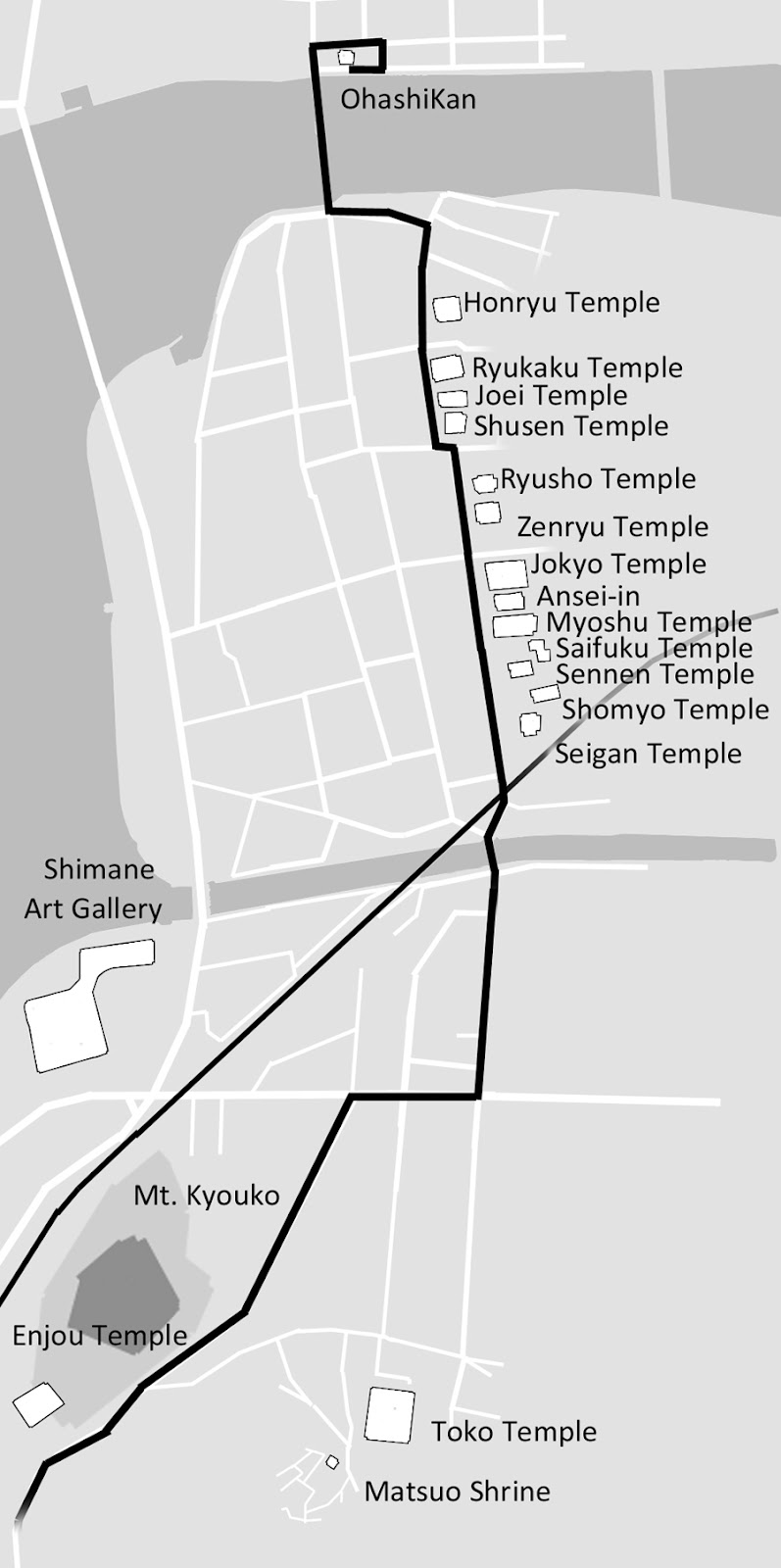

He begins on the north shore of The Ohashi River, at the inn where he originally stayed named Tomitaya Inn. There’s still a hotel there called OhashiKan and, while there is an information board about Hearn by its entrance, it has precious few links to the old inn.

He goes into some length about the songs of birds, the emergence of schoolchildren and the comically loud horn on a new ship docked at the quay that used to sit on the river’s southern shore.

He guides us through a road that he calls “The Street of New Timber” which is the narrow road running parallel to the river on the other side of the inn. Hearn describes nets hung up on poles higher than the houses because, despite its name, the street housed fisherman. These days, the only poles here hold up Japan’s complicated network of air-borne wires and cables. These do have an air of Lafcadio’s “prodigious cobwebs against the sky,” but I suspect the atmosphere has changed considerably over the years.

Then he crosses the Ohashi bridge, admiring the mountain Dai-san in the distance to the east as he does (this part, at least, has not changed since Lafcadio’s time) and he describes a very small Jizo temple at the end of the bridge which has now gone.

He writes at length about this bridge. During his stay it was rebuilt, changing from a bridge that "curved over the flood, supported on multitudinous feet like a centipede of the innocuous kind" to an iron construction whose girders formed triangles along the bridge.

Lafcadio describes a well-known fable relating to the bridge. It states that the construction was beset by difficulties and the pillars of the bridge would repeatedly be swept away no matter how many stones they sunk into the river bed. Finally, the daimyo who was overseeing the construction of the new city, decided the only course of action was to have a human sacrifice: a hitobashira, or human pillar, who would be buried alive in the structure of the bridge.

The choice was made at random: the first person to cross the bridge wearing hakama (a kind of trouser) without a machi (a rigid board that covers the knots of the hakama at the back) would be the victim. One man, named Gensuke, crossed in this manner of attire and was swiftly made a sacrifice. According to Hearn, this lead to the bridge standing firm for another three hundred years. The middle pillar of the bridge was called Gensuke’s Pillar, and a flickering red light was sometimes seen over the bridge. Hearn recounts this legend in a newspaper article where he describes in some detail the opening ceremony of the 15th Ohashi Bridge.

Hearn explains how the widespread belief in the Gensuke legend persisted to his present day: how the building of the new bridge caused rumours to circulate that a similar fate could await some unsuspecting citizen: not the first to cross it, but the thousandth. Hearn writes how the question “Has the victim been caught yet?” was commonplace among visitors as they arrived. Despite the superstition, people still flocked to the opening ceremony. Hearn guesses the crowds numbered twenty thousand and said the river was so full of boats of spectators that “one could easily have passed the Ohashi by stepping from one to the other”. When the ceremony was over and the bridge became open to all, there was a huge roar and the citizens of the town swarmed across it, all suspicions apparently forgotten.

Then Hearn guides us towards Tenjinmachi which, he reminds us, is also called the Street of the Rich Merchants. As we approach the end of the bridge looking south, it is directly ahead of us. The dark blue hangings with “white wondrous ideographs” that adorned the shops on both sides have gone. As has much of the energy of the area. Hearn said it contained “the richest and busiest life of the city” where you could find many curious temples as well as “the theatres, and the place where wrestling-matches are held, and most of the resorts of pleasure.” This all changed with the opening of the train station in 1911 which meant goods would no longer arrive in Matsue via Lake Shinji, so instead the area around the station became more prosperous and Tenjinmachi slid into decline. Now this area is best known for its aging population.

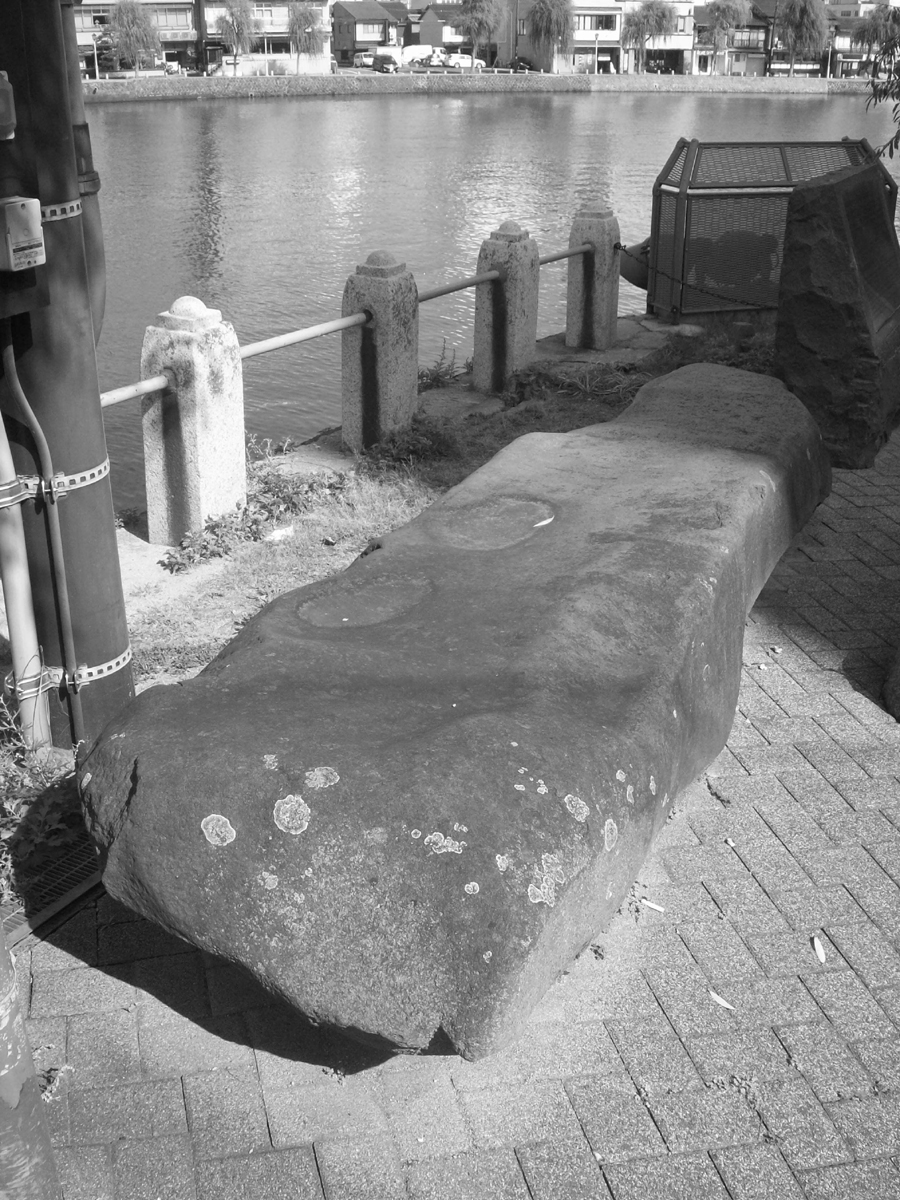
We won’t go this way since Lafcadio doesn’t go into any real detail about Tenjinmachi in his book. Instead, we’re going to take a left once we step off the bridge, past a small memorial to an engineer who died in the construction of the current bridge. There is also a long, flat roughly hewn stone here with an information board beside it. This is a musical stone of Oba which, according to the legend recorded by Lafcadio, can only be transported a certain distance. Apparently, one of the Matsudaira feudal lords (Hearn doesn’t specify which one) wanted one in the castle grounds but as they approached Ohashi Bridge the stone became so heavy that not even a thousand men could move it so they left it by the bridge, where it remains to this day.

Walk past this stone and follow the road as it bends south. Now we’re heading into the neighbourhood called Wadamicho (多見町) towards Teramachi (寺町 lit, “Temple Town”) which is a neighbourhood where temples cluster together. When the city was created in 1611, this area also served a military purpose in that the walls of the various temples would offer at least some defence against any attacking forces coming from the south-east. Hearn describes this area as “masses of Buddhist architecture mixed with shreds of gardens and miniature homesteads, a huge labyrinth of mouldering courts and fragments of streets”. When Hearn wrote about these temples, he was struck by how children use the forecourts as playgrounds and how many of them have wrestling rings in the grounds where people can wrestle or watch for free during the summer months.

Things are a little different now, of course. While a district of temples with a history dating back to the 1600s sounds a chance to stroll through avenues of ancient architecture redolent of a vanished age, then one needs to be reminded that these temples are all still in use. The religious sites in Teramachi are pristine and, often, quite similar with black tiled buildings, a courtyard, and little else to distinguish it from its near neighbours. Additionally, Teramachi is no longer on the outskirts but is in the centre of the city, barely ten minutes’ walk from the station, such that any sense of quiet contemplation can't really be sustained while walking from one temple to the next. But we’ll head this way and I’ll try to give a little history of the place with whatever stories I happened to have heard.

The first temple we come to is on our left and is called Honryu Temple (本竜寺 Honryuji) this temple is more notable for what it lacks than what it has. In 2018, its 175 year old gate had to be demolished because it had become so weak that it would be a hazard in an earthquake. Now, in it’s place, is a clean white wall with pillars either side of the entrance where the gate once stood.

As we continue we soon come to, on our left, Ryukaku Temple (龍覚寺 Ryukakuji) whose gate is still intact – a gleaming white edifice of smooth concrete (I assume). This temple houses a Buddha statue that was found floating in Lake Shinji by a sailor. Next is Joei Temple (常栄寺 Joeiji), which is so close that it shares the same external wall as Ryukaku Temple but whose history eludes me.

Carry on following the white wall until we come to a staggered crossroads, with the road heading south a little to our left. At this junction is Shusen Temple (宗泉寺 Shusenji). I mentioned before how temples would hold wrestling matches, and this temple hosted a fight between two martial artists. One was a monk, Takeda Matsugai, who was famous for his feats of strength. People would ask him to punch wooden pillars in their house, leaving behind the imprint of his fist, as a mark of friendship. He stayed at this temple in 1850 and during that time and he fought against Ogura Rokuzo, later to become the 11th master of the Jinshinryu school of Judo. Matsugai won by throwing his opponent into some tea plants.

We’ll continue south, now walking through Teramachi itself, and we’ll soon arrive at Ryusho Temple (龍昌寺 Ryushoji) with an information board relating to Lafcadio Hearn. It tells us that he would often walk around the graveyard here and once happened upon a Jizo statue. Struck by its beauty, he asked if it were the work of a master craftsman which, indeed, it turned out to be. This confirmed Hearn’s reputation as a connoisseur of art.

The next temple along is Zenryu Temple (全龍寺 Zenryuji). It’s records were lost in a fire, but it does have one notable feature from more modern times. In the cemetery here is the grave of Yamauchi Kakugawa, a poet who was born in the adjacent neighbourhood Tenjinmachi in 1817. Tenjinmachi would have been at its height of its powers as a hub of trade and entertainment at this time. He became an antiques dealer which kindled his interest in the tea ceremony and, from that, haiku poetry. He corresponded with a poet in Kyoto and became more determined to follow poetry as a vocation.

One day, he performed a tea ceremony for his wife as a symbolic way of saying goodbye and, three days later, left Matsue during a snowstorm. He studied in Kyoto and then Edo, before travelling north. Finally, aged 41, he returned to Matsue where he built a hermitage and taught about poetry and the tea ceremony until his death in 1894. His gravestone here carries the inscription 何ひとつ見えねど露の明りかな “I can see nothing but the light of the dew”.

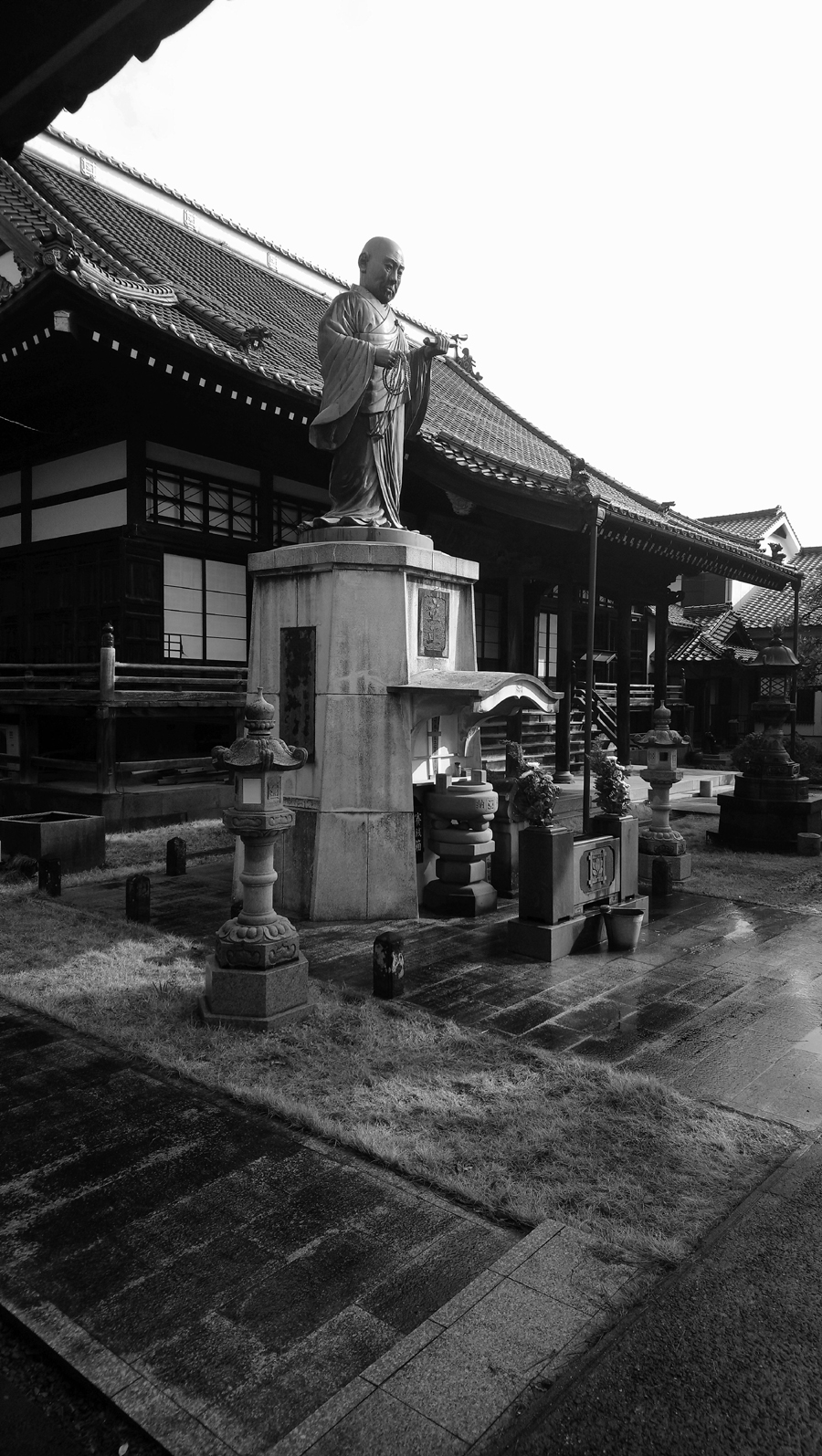
On reaching the crossroads and we can already see the next temple sitting on the junction, just ahead and to our left. This is Jokyo Temple (常教寺 Jokyoji) a temple of the Nichiren Buddhist sect with a statue of Nichiren beside the gate as you enter.

The cemetery here houses the grave of Kobayashi Jodei, a local woodworker who died in 1813. He worked for the 7th lord of Matsue, Matsudaira Harusato, and was famous in his day for his skill. He was also an alcoholic, apparently always drunk, and even invented a wooden sake cup that wouldn’t leak. One story about him details how a young carpenter, indignant that such an old soak should enjoy the patronage of the feudal lord, challenged him to a wood-carving competition...

Kobayashi agreed on the grounds that they both carve mice. The next day, in front of several people, they presented their works. The mouse of the younger carpenter was exquisite. The fur, the tail, the ears, everything was done to perfection. The mouse carved by Kobayashi, well, it looked like a mouse, but was a little sloppy. The young challenger was announced as the winner when Kobayashi raised an objection.

“Surely the best judge of which is more realistic should be a cat,” he insisted and his opponent, thinking it would make no difference, happily agreed.

So a cat was brought in and the two wooden mice put in front of him. The cat immediately pounced on Kobayashi’s mouse and the contest was definitively decided in his favour, leaving the challenger ruing his insolence and amazed at the talent that could fool a cat.

Later that evening, Kobayashi was out drinking when the bartender asked him why he thought the cat preferred his.

“Well,” said Kobayashi, “his mouse was better than mine but, the thing is, he’d carved his from wood, while mine was made from dried fish.”

Following on from this are a number of temples about which I can find little. The first two have impressive gates while the ones further south are tucked away behind shops and houses, accessible down paved alleyways.

Finally we arrive at a junction where the railway line passes overhead. Looking to our left we can see the green roof of another temple gate. This one, the southernmost in Teramachi, is Seigan Temple (誓願寺 Seiganji) and was once a favourite of the Matsudaira family, famous for its opulence.

After this, Lafcadio Hearn passes over the Tenjin Bridge which as far as we’re concerned is under the railway and down the road as it veers right. In Lafcadio’s day this passed over the Shinedote River, but this is now called Tenjin River, and this road lead into what was then a more run down densely populated area with “many a tenantless and mouldering feudal homestead.” These days it’s a residential area whose roads are shaped by the railway line running through it, but it isn’t particularly decrepit or abandoned.

He heads south-west to a soba Noodle shop named Kuribara where he can watch the sunset over the lake but gives scant details that we can follow. However, further south of this neighbourhood there is another location that he wrote about: Toko Temple. He visited here in unfortunate circumstances – for the funeral of one of his students. Hearn described the interior of the main hall, with its candelabras with brass dragons and vessels shaped like deer, tortoise, and stork, but most profoundly he recounted the bell and the sound it made on this onerous day. “Peal on peal of its rich bronze thunder shakes over the lake, surges over the roofs of the town, and breaks in deep sobs of sound against the green circle of the hills.”

After his visit to the soba shop, Lafcadio briefly describes his journey as he retraces his steps. On his way back over the Tenjin Bridge in twilight he passes a woman praying for her dead child, dropping strips of paper into the water below, each one with the image of a Jizo Buddha and perhaps an inscription upon it. Once back at the inn, Lafcadio describes the final sounds of the day and the “soft Buddhist thunder” of the bell at Toko Temple in the distance, a few streets from the Soba shop he’d visited earlier.

This passage, which takes up Chapter seven of Glimpses of an Unfamilar Japan, is endearing in its lapses into rhapsodic utterances over minor details. He diligently transcribes the calls of the street vendors, describes students marching past and lists any number of minutiae so banal that most people wouldn’t even think to write about them but Lafcadio captures them in style so we can revisit his Matsue, sharing in his joy at every new discovery.

Hearn’s life in Matsue was by no means perfect. The winter, in particular, disagreed with him. Unable to face a second winter Hearn left Matsue in the summer of 1891 for Kumamoto in the south and, initially, the change was not a happy one. He found the locals too reserved and even the local superstitions which had so delighted him before now seemed hopelessly backward. But the climate suited him and, in time, he came to appreciate his new home. In 1894 he moved to Kobe to work for a newspaper there. In 1896 he became a Japanese citizen and took the name Koizumi Yakumo. A year after this he took a teaching post in Tokyo and lived in that city for the rest of his life.

Lafcadio Hearn passed away in 1904 of a heart attack. The renown he’d built up during his lifetime in the West was slowly undone by Japan’s military expansionism which didn’t sit well with Hearn’s image of a quaint spiritual Japan. Meanwhile, In Japan he initially remained a largely unknown figure, even in the town he most adored. The French author Andre Bellessort visited Matsue in 1919, keen to see Hearn’s home for himself, but he had to go to the local government offices before he found someone who knew where it was.

This changed in the 1920s when Hearn’s work was translated into Japanese for the first time. The Japanese ruling elite were keen to spread the word about this author as an example of a Westerner who really understood Japan, and whose emphasis on old traditions and legends was an image of Japan they wished to maintain. Lafcadio would have been appalled at his work being used to support a regime that he’d despaired at during his lifetime. In his later years he became more cantankerous, disappointed at the country Japan had become. “Carpets – pianos – windows – curtains – brass bands – churches! How I hate them!!” he wrote. A friend of his, Yone Noguchi, recalled Hearn had once said “What is there, after all, to love in Japan except what is passing away?”

These days his reputation sits uncomfortably on two stools. He could be considered as a chronicler of places and stories that most journalists wouldn’t even consider and, as such, he was remarkably ahead of his time. On the other hand, he was a traditionalist, overburdened by nostalgia and spending most of his later life basing his writings on memories or old note books rather than the rapidly-changing world outside. But for all his faults he remains an important and engaging writer from the late Victorian-era who captured something of a now disappeared Japan.
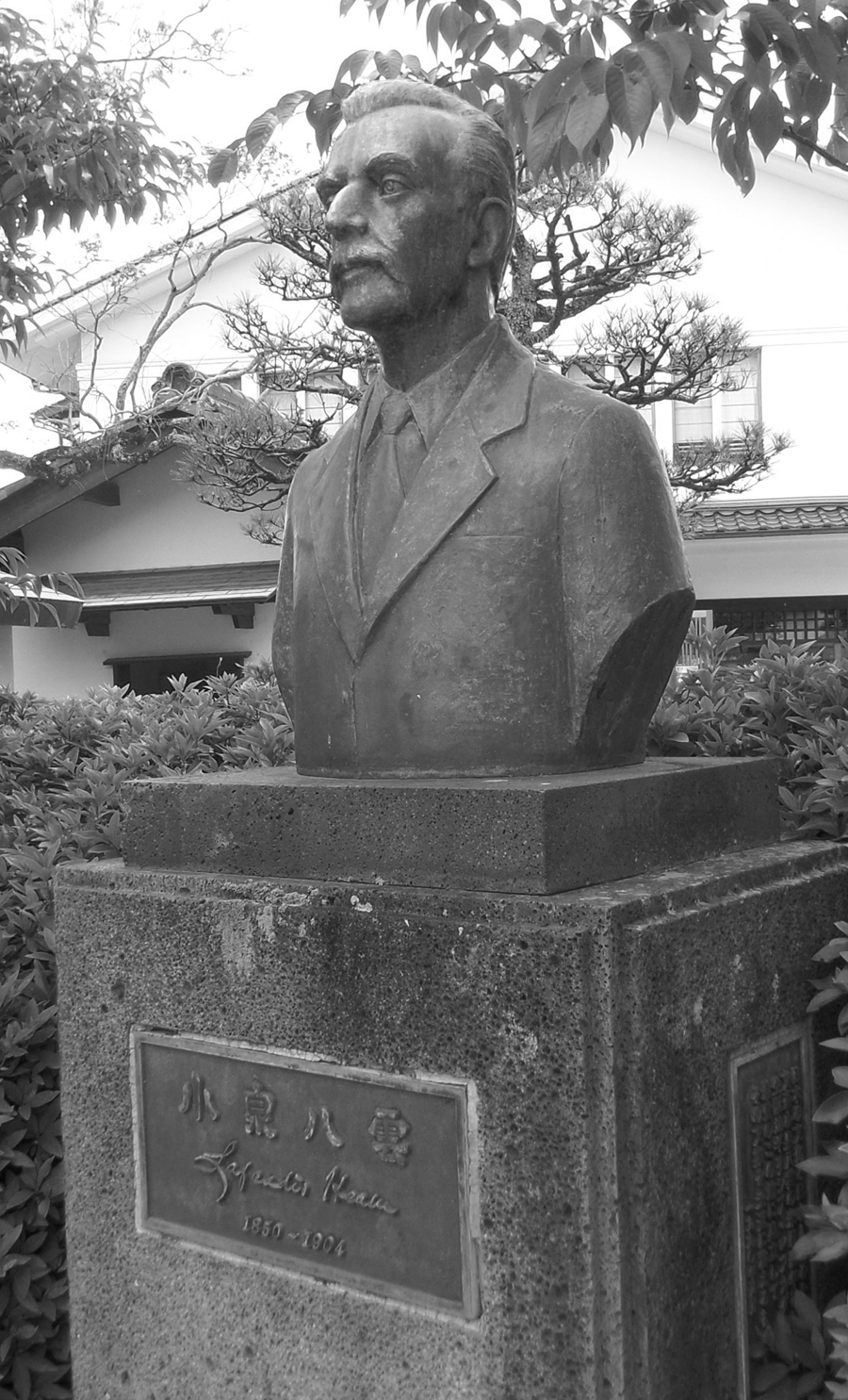

Lafcadio Hearn’s last visit to Matsue was in 1897, just before he moved to Tokyo. He wrote about it for the periodical Atlantic Monthly where he explained his trepidation

“I felt curious in advance as to the nature of the impressions I was going to receive on revisiting, after years of absence, a place known only in the time when I imagined that all Japan was like Izumo.”

He visited his old house with its much-loved garden and the school where he’d taught and, most importantly, an old friend Sentaro Nishida who was suffering with the later stages of tuberculosis.

Hearn’s final departure from Matsue was by steamer, departing from a quayside near Ohashi Bridge where he had first arrived. He was accompanied by Nishida despite the stifling summer weather. This would be the last time that the two friends met and Hearn expressed a pang of regret at his friend’s hospitality in a letter he wrote shortly after.

“I felt unhappy at the Ohashi, because you waited so long, and I had no power to coax you to go home. I can still see you sitting there so kindly and patiently – in the great heat of that afternoon. Write soon – if only a line in Japanese – to tell us how you are.”

And he ends the letter with a brief sentence below his signature that reads,

“I still see you sitting at the wharf to watch us go. I think I shall always see you there.”


Thursday, 18 July 2019

I've written a book about Japan

After a recent trip to Japan I found myself a bit perplexed that there was no book about Matsue on the market (apart from Glimpses of an Unfamiliar Japan by Lafcadio Hearn, but that’s over a hundred years old). So I sat down and wrote one!

It’s an introduction to the city, but very much from my experiences there. I did a little research to add a little background, but it is by no means a history of Matsue. I thought I’d mention it here on the off chance it’d interest you. It’s on Amazon only (self-published Kindle, you see).

It’s subtitled The Storytelling City and, as I explain on Amazon, “Of course, every city can tell you stories, but Matsue is almost overburdened with them, stretching back over a thousand years. From myths described in ancient texts, through the tales of the Edo period and on to a Victorian ghost story collector, it seems as if every street has, over time, acquired some kind of fable. Around all of this is a small city of uncommon beauty and character.”


Friday, 27 June 2014

Japanese schools in revolt

Keio University in Tokyo is one of the most prestigious in Japan. It’s also the oldest seat of further education, being able to trace its roots back to a School of Western Studies established in 1858.

But in 1888, it was one of a couple of schools suffered from student rebellions, as the students went on strike to complain about the teaching methods. One of the foreign teachers there, Rev Arthur Lloyd, wrote to a newspaper in England about the then current demonstration.

Rev Arthur Lloyd, from The Open Court, 1912

“The Tokyo students have lately taken to rebellion. A few weeks ago, the students at the Methodist School at Azabu rebelled and struck against their teachers. I believe this was owing partly to the unpopularity of their new principal and partly to alleged favouritism as between Christian and non-Christian students. However, unfortunately, after a strike the students were victorious. Several obnoxious teachers were dismissed to please the students and after several concessions had been made, the boys condescended to come back to their duties.”

Rev. Lloyd notes that this successful strike was followed by another in the same region of Tokyo: Azabu. This time, in the school where he was teaching: the afore-mentioned university, or Keio Public School as it was then known.

“Our new manager, Mr Koidzumi, is a terrible new broom; unfortunately, he has been appointed senior manager. The consequence was that he introduced all manner of new rules into the school, especially some rules about daily marking, which were most obnoxious to the students. With the exception of two classes, the whole school struck and now the conflict is raging. Forty of the ring-leaders have been expelled, more than 300 boys have already left the school, and I am not at all sure how the result is going to turn out.”

This letter, written on 21 February 1888, goes on to explain that the foreign teachers have no say in the matter: it is an issue purely between the Japanese. Whatever sympathies he had with his students, he thought the strike was worth facing down, if only to stop the rebellions spreading to other schools. He also wonders if the new younger generation, with their multi-cultural education were perhaps looking down upon their monolingual parents and their Confucian education.

Although the letter was written in the midst of the troubles, with no solution in sight, Rev Lloyd did write about this again. In his book “Every-day Japan” he explains how it ended. The book was written in 1909, and a couple of details don’t match the contemporary report, but this is what he wrote:

“The biggest affair of this kind that I remember was in 1885 or 1886, when the whole of the great Keiogijuku College, with the exception of one class, went out on strike over some grievance about class-marks, and refused for more than a month to receive the instructions of their professors. When the strike was finished, students and professors had a grand feast of reconciliation in the playground, where speeches were made and toasts drunk. A short time ago I still possessed a big photograph of this entente cordiale established between teachers and taught.”

What a shame he didn’t still have the photograph to include in the book. It would have been a beautiful reminder of a turbulent period of change in Japanese society. Rev Lloyd goes on to tell the readers of his book that this events all happened decades ago.

“School strikes on a very small scale do indeed still take place from time to time, but they are mild affairs when compared with the heroics of the past. The go-ahead student of twenty years ago is the go-ahead parent of to-day, and has succeeded in re-establishing over his children that parental authority which for the time slipped from the grasp of his old-world father ; and the crude teacher of the early days has made room for the better trained teacher of to-day, so that the whole atmosphere of the Japanese school has undergone a change for the better.”

References

http://en.wikipedia.org/wiki/Keio_University
“Rebellious Schoolboys In Japan,” Bury and Norwich Post, 1 May 1888, page 5
Lloyd, Rev. A, (1909) “Every-day Japan,” Cassel and Co. Ltd, p 272-273
Clement, E. W. (1912) "The Late Rev. Arthur Lloyd (With Portrait).," The Open Court: Vol. 1912: Iss. 4, Article 8

Friday, 20 September 2013

Finding Japanese streets, after seventy years

Recently I had a small but satisfying episode in which I discovered the location of an old film clip from Japan that I’d been trying to track down for ages.

I first saw the clip about a year ago. It’s a collection of slow tracking shots along various Japanese streets, film sometime in the 40s, after the war. It's quite interesting, especially the bit where a woman says goodbye to her husband and then, after walking a few paces, meets another friend by chance. I decided I would try and find out where it was. I translated a few of the signs, and got as far as working out it was probably in Tokyo, before giving up.

Last week, I found it again, and had another attempt at tracking down the location. I had no luck, so I decided to show it to a Japanese friend. She was able to translate a few more of the signs, including one I had got wrong. She pointed out Hibiya Byouin (Hibiya Hospital) and Tamura Machi (Tamura Town). I took some notes and later that day sat down to try again.

This time I got it down to an area. I found Hibiya Park, but no hospital, and then, by taking some screen shots and zooming in, which meant I found a road sign in English pointing to Shimbashi Station. This, coupled with the fact that a train could be seen passing over a bridge, narrowed the choices down to three or four.

(Shimbashi Station sign top right)

Then I realised that the second clip was actually the same street as the first clip, only with the camera pointing in the other direction. And this time, there was a tram passing by. Suddenly, this became a big clue, but with the tram lines long since removed from streets and no street/tram map from this era online, I was missing the final piece of the jigsaw.

But the other day, just by chance, I was looking through some old maps online. To my surprise I found this site which did have that magical mix of street maps with tram lines. And when I looked at my suspected area, I found a tram line with a station called Tamura Machi right on one of my potential roads. This was the clincher! I'd found it! It was Sotobori Dori, in the Nishishinbashi area, just south of the Imperial Palace.


Of course, nothing is the same, except the width of the road. Everything else has changed since then. Shops, pavements, signs. Even the trees are new. I searched in vain for one thing that survived but I could not.


Tuesday, 26 February 2013

Accidental poetry

Recently, I was using an online Japanese-English dictionary, looking up meanings for the character "zan" 残. I was going through all the different uses that this character had when I noticed that the first few dozen examples seemed to have a poetic quality to them. Now, I'm no expert, but I thought it was worth sharing. So, with minimum editing from me (the original page is here), I present to you a piece of accidental poetry that I call

Definitions of the character "残"

Alas,
Bad luck.
Don't let it get to you.
Game over.
I'm sorry to hear that.
That sucks.
That's too bad.
What a bummer.
You got to be kidding me!

Remaining snow
An incidental image
Residual quantity
Lingering summer heat
Not at all
Remains

The ruin of a ship
A residuary bequest
Leave place for...
Overtime pay
A ledger balance
Insensate brutality
Leave an impression
Eat every bit
Remain behind
A barbaric punishment
A credit balance
To a man
Nobody left on base

Wednesday, 6 February 2013

More photos of kanji

When I was in Japan, I found an old Orihon, a Japanese book which is one long sheet of paper folded over to make pages. It's not worth anything: it cost 100 yen (about 70p) in a second hand bookshop and is very battered and worn, but I think it's quite pretty. The damage caused by paper-eating insects just adds to the charm.


Friday, 25 January 2013

The Curious Case of Watanabe Kinzou's House

In the years 1925-26, after the Great Kanto Earthquake, Watanabe went on a trip around the world. When he returned he began to renovate his building situated in the corner of a shopping distrcit in Fukagawa, Tokyo. He began in December 1927, but only gave verbal instructions to the carpenter – no blueprints were made – and work was frequently postponed while he made changes.

In August 1931, the building was completed but Watanabe soon began further construction work on the house. During this time, unable to tolerate his strange behaviour any more, his family left him, leaving him alone in the house with a maid. In the Spring of 1936, Watanabe offered to give up his free phone line, which was quite valuable. The authorities couldn't understand why, but they removed the telephone all the same. By chance, his estranged family heard about this, and thought it reason enough to hospitalise him. Two years later, his house was torn down.

Source


The psychiatrist Shikiba Ryuzaburou wrote about it in a magazine in 1937, and these articles became a book, 「二笑亭綺譚」 (no official English translation, I'm afraid) which is now out of print. He tried to save the house, insisting it should remain standing as a work of art, but to no avail.

From the article on Wikipedia Japan, and other sources, I've collated this incomplete list of curiosities about the house.

The plot of land measured 95.7 tsubo (a tsubo is equal to 3.95 square yards or 3.31 square meters) but the floor space only added up 67 tsubo.

Despite being a two-storey wooden house, the storeroom and kitchen were made of steel.

Three large windows at the front on the second floor in a curious arrangement.

The ceiling of the entrance hall, just as you enter, went all the way up to the roof.

Hooks for hats and coats were placed in a haphazard manner, at a height of four metres.

The back gate was blocked by a diamond framework, so that it got in the way of anyone going out or coming in.


Detail from this source

Peep holes in the thick wooden fence around the house, made in the knots in the wood and filled with glass.

A Japanese-style bath and a Western-style bath next to each other

A ladder out of the roof that doesn't go anywhere

A titled set of shelves

Interior walls painted with a mixture that included insect repellant

A ladder in the storehouse that just went from floor to ceiling


Source

Unusually shallow closets of just 30cm deep

The toilet is separated from the courtyard by only the lower half of a door

One source mentions many rooms that were unusable, but doesn't specify why. Or perhaps I've mistranslated.

Source

References
http://www.yama-semi.com/?pid=22482951
http://www.yama-semi.com/?pid=22485162
http://kizen.bunko1.com/105/200-1/50.php
http://members2.jcom.home.ne.jp/nishikawaw/nishotei02.html
http://members.jcom.home.ne.jp/0350371001/works/works_1_a.html
http://book.douban.com/subject/1941758/discussion/22127595/
http://ja.wikipedia.org/wiki/%E4%BA%8C%E7%AC%91%E4%BA%AD
http://yamanochikara.com/column/vision/2965/

Note:
I have followed the Japanese style of name order, such that Watanabe is the family name, and Kinzou was his given name.

Saturday, 3 November 2012

Tuesday, 30 October 2012

Sunday, 21 October 2012

Kanji and decay

While walking around Japan and taking photos, I've become interested in occasions where kanji characters have become aged or distorted by natural processes. Perhaps something to do with it being a means of communication which, still, seems impenetrable to me which also has to get past an extra hurdle of the passage of time or the transience of materials.


Wednesday, 30 May 2012

Skytree predicted in 19th century Japanese art


Recently I heard about a Japanese art print dating from the 1850s which appears to predict the construction of the Skytree: Tokyo’s newest and tallest building.


The English title of the painting is “Caulking Boats” and it was drawn by Utagawa Kuniyoshi and in the background, a cityscape can be seen. Next to a watchtower, there’s a strange spindly tower rising far above the rest of the buildings. This building looks so odd, that it’s easy to believe that it was never actually there and may have been part of some kind of vision.

The first time I saw it, I found it quite a convincing piece of evidence for a premonition. It was definitely from the 1850s, and I couldn’t even begin to imagine what the purpose of such a building would be.

However, it’s easy to misinterpret images from other cultures and ages, so I tried to find out more to put it in context. I couldn’t find any contemporary reaction to the art work, since what may be mysterious to us, may not be mysterious to someone of that time.

While researching this, I’d often read blog posts with a quote from a professor, stating that this tall tower can’t have existed, since no building was allowed to be taller than the Imperial Palace, giving their articles a touch of academic research.

Before long, I found that this type of structure had been depicted by other artists in other pictures. It appears to be a tower that’s used in the making of a well. It’s an exaggerated version of one, certainly, but that’s what it seems to be.


I’m interested about the stages this picture went through before it became this big mystery. First, the people looking at this at the time, it would’ve been obvious what it was. Then there must have been a time, where no one really paid it much thought. People either knew what it was, or they didn’t find it mysterious. Then finally, the print was reassessed in light of the new structure by which time, most people were unable to identify the structure’s initial purpose.


It’s a fascinating example of how, when faced with gaps in our knowledge, we fill them in with our own ideas of how things ought to be according of our understanding of the current world. Rather than trying to see things through the eyes of a contemporary witness.

References

http://www.ukiyoe-ota-muse.jp/H2405viewfromthesky-E.html

Wednesday, 7 March 2012

Everyone gets a share of the pi

While reading about the history of mathematics in Japan I found a mathematical sequence which, for reasons I do not know, happens to contain a lot of the estimates for pi that have been put forward throughout history.

This sequence was discovered by Seki Kōwa and was published in 1712 after his death in a book called Katsuyō Sanpō. It runs as follows:

Start with the fraction 3/1. If this number is lower than pi, then increase the upper number by 4. If it is greater, then increase it by three. Then increase the lower number by one. And continue like this.


If you do this, you get a sequence of numbers that includes the estimates of pi from different people from different times in history. In this list (mostly Chinese mathematicians, since up until then Japanese maths was heavily influenced by Chinese textbooks), Kōwa finds the values from Chih (25/8 or 3.125), T'ung Ling (63/20, or 3.15), the “old Japanese” value (79/25 or 3.16), Liu Chi (142/45 or 3.155), Hui (157/50 or 3.14) and also 355/113 (which is very close to the actual value of pi at 3.14159292) but this isn't credited to anyone, so Kōwa must've known about it's use as a value of pi, but not known that Tsu Ch'ung-chih had found it.

I like mathematical sequences that seem to have a narrative, although I doubt it has any use. I don't think the series converges on the true value of pi (I haven't checked) but it does occur to me that this isn't a very good way of calculating pi, because it only works if you already know the value of pi.

Reference
D.E. Smith, Y. Makami, “A History of Japanese Mathematics”, Open Court Publishing Company, Chicago, 1914, p111-112

Wednesday, 27 April 2011

Me and Google agree

While looking on Google Maps for places in Japan I’d been to, I saw that a walk I'd done now had street view images. So I looked at it, and compared it to the photos I'd taken when I was their last year. I noticed the similarity between the two images below. Either the Google pictures were taken around the time I'd been, or that car's owner is very particular about how to park cars, or it hasn't been used at all.


Wednesday, 10 March 2010

Back in Osaka

And so the wheel turns full circle and I'm back where I started for a couple more days before I fly back. Tokyo gave me a bit of a shock one evening when it started snowing. I was walking back to the hotel and I looked up with a rueful smile at my bad luck. What I should've done was grab someone and demand an explanation, as the snow soon picked up and was whipped about by a pretty merciless wind. As I approached Shinjuku I was impressed by the sight of the skyscrapers disappearing up into the low cloud, their lit windows gleaming while the snow flurried around. I would've taken a photo, but my hands were two blocks of ice and refused to do anything fiddly like operate a camera or even open and close.

Monday, 8 March 2010

Tokyo

Arrived yesterday, although the drop in temepature and driving wind and rain didn't make me feel too welcome. Tokyo's okay. Today has been hard on the feet, as I set out for Akihabara, spent ages looking at things, and then made my way back again. Tokyo definitely has that capital city vibe of "this is the place where things get done, so would you mind getting out of my way?" although Tokyo adds a "please" at the end.

Friday, 5 March 2010

Kyoto

I arrived in Kyoto a couple of days ago and yesterday I decided to walk a mountain trail I had seen described in a book. And since I was going to walk in the mountains, I thought, I may as well walk to the start of the trail since - according to my map - that was a pleasant walk along the river. Which, indeed, it was. But it was a two hour walk along the river. Even stopping for a coffee before carrying on didn't fully recharge my batteries, but it was too late to go back now.

So I set off, not exerting myself too much and before too long - perhaps an hour and a bit - had reached the summit of the mountain - Daimonji ("large charcter", so called because during a festival a giant kanji character of the word "big" 大 is lit up on the side in fire).


So I figured I was making good time. I continued the path, making sure to always check the signs at junctions so I was heading towards the next spot on the trail. As it turned out, this too a while. And while I was expecting a steady descent, the path meandered about, going down and then - cruelly - up and with each sign it still pointed towards this place I was heading to with no indication if I was getting any closer. This went on for an hour, with my legs getting increasingly tired. If I hadn't had a compass with me to reassure myself I was always heading south, I'm sure I would've thought I was going in circles.

Finally, arrived at this place but that was cold comfort since the book assured me that after this was another hour of walking. At least for now on it was all downhill, and there were some pretty interesting little shrines dotted along the way, and a waterfall where buddhist pilgrims pray nude while standing under it. No photos of that, since there was one there disrobing as I went past and I didn't want to intrude.

Finally got back into Kyoto after four and a bit hours in the mountains and collapsed into the nearest coffee shop.

Tuesday, 2 March 2010

Old man in park

While out for a walk, I sat in a park for a bit of a rest and to read a book. Before long an old man had come up to me, asked if I was American, and then invited me to chat. I said okay and so we wnt back to his bench where he'd been drinking whiskey and iced tea. We then spoke (mostly in Japanese, mostly him) about his daughter (half-Phillipino, sixteen years old, which means he must've been about fifty or sixty when she was born, so well done to him) and how the Japanese are happy people, and his job as some kind of agent who works to solve disputes between companies. At one point he started whispering and I get the impression he was telling me a terrible secret. I didn't undserstand a word of it, apart from someone going to prison for ten years. Possibly him.

He then pointed to his bicycle and explained he didn't live in Osaka, but only came in to by instant noodles. I have a hard time imagining any town in Japan that doesn't sell noodles locally, but I didn't ask for details.


At one point, he said he was just going to the toilet, so I said okay. Although the were some public lavatories in the park not far from us, he just walked a little distance away and started pissing against some bushes! I wasn't sure where to look (although "not at him" was the obvious first choice) and tried to pretend that nothing weird was happening.

Monday, 1 March 2010

The Takedao Tunnels

One of the things high on my list of things to do was to visit the Takedao Tunnels. I'd read about them and found it interesting that a disused railway had been turned into a nature trail, despite the presence of some very l0ng, dark tunnels along the way. So, armed with torch, I took the train out of Osaka to try them out.

On the walk from the train station at Takedao to the start of the hike I passed passed two signs giving off bad vibes. One was a sign warning women of the danger of muggers, and the other was a hand-made sign in Japanese, the only word of which I understood was "abunai" (danger). I hoped that whatever the sign was about, it didn't refer to the walk.


The first tunnel was a good introduction to the walk, not long and gently curving so you can see the end before you begin. The second was just straight ahead, so didn't offer any real problems. And between the tunnels there were some beautiful views of some tree covered mountains and a raging river.


Tunnel three was the first to offer up some challenge. For a start there's a big sign in front of it, which looked a lot like a warning, but I couldn't really tell. There was also a photographer nearby having a cigarette but most importantly, to my discomfort, on the ground at the mouth of the tunnel was a dried, withered bunch of flowers held in place by two stones. They looked somewhat funerial, but I gritted my teeth and entered the tunnel.


This was the first tunnel where I needed my torch, so I switched it on. I was disappointed that, after seeming so bright when I tried it out in my bedroom, it seemed to struggle against this much darkness and could only offer a rather pale yellow beam that let me see where I was about to walk but no further.

About a third of the way in, I heard other footsteps and, looking behind me, I saw that the photographer had started to walk through too. I could see his silhoutette and the light from his torch. He was some distance back so I didn't give it much thought. Later, as I was approaching the end, and the beginning of the tunnel was no longer in sight, I realised that I couldn't hear the photographer's footsteps, nor see the light from his torch. I guess he either turned back or stopped to take a photo. Either way, I found his disappearance a bit disconcerting.

Tunnel four was a doddle, but tunnel five really lived up to the trail's reputation. It's very long and, for the most part, in total darkness. In this situation, your mind can't help but play tricks on you, such that a white streak on the wall fleetingly picked out in the edge of the torchlight gave me quite a shock until I double checked and it was just a white mark on the wall. After a while, you notice how the brownish stains of water on the wall resemble blood and I don't know why but a row of sleepers propped up against the wall really disturbed me.

Tunnel six was another straight ahead one, so no challenge there. Finally I got to the end of the route and arrived in a different town. This was something of a let down after majestic mountains and the rolling river. I then realised I didn't know where this town's train station was, and after a bit of a sit down, I decided that instead of wandering around an unremarkable Japanese town looking for a railway station that could be anywhere, I could just go back the way I came. The walk wasn't long or physically difficult, so why not? It was a great walk in the other direction, too.

Sunday, 28 February 2010

In Japan

I'm currently in an internet cafe in Osaka typing to you, and as I do, I'm imagining the words being spoken by a plummy 1930's BBC announcer talking to you all the way from Ally Pally.

There's going to be a tsunami tomorrow, according to the TV. In fact every channe; has an icon in the corner of the screen of Japan, with the coast line colour coded according to the level of sea rise. I'm not feeling too worried myself since I'm quite a long way inland and on the 7th floor, but I do wonder if I'm taking my holiday in the middle of a little bit of history. We shall see: the last tsunami warning the Japanese gave out was withdrawn soon after so we'll see how long this lasts.

The flight was okay. Only got three hours sleep in the whole night, so I'm feeling a bit wired. Interesting things I didn't know about Japan is that the layout of the seats in train carriages can be arranged by switches near the driver's cabin. I watched as one guy made all the seats in all the carriages turn on the spot so they were facing the other way.

I also successfully piloted my first Japanese toilet, managing to avoid the "spray my bottom" button (not a literal translation, I admnit) and hit the flush button instead. Good job too, since I wasn't sitting down at the time and it would've sprayed most of the cubcile door. Anyway, inbuilt bidets aside, I can't say I'm too keen on the heated seats. It's like you'll always feel that someone's done a poo just before you did.