Recently, I was using an online Japanese-English dictionary, looking up meanings for the character "zan" 残. I was going through all the different uses that this character had when I noticed that the first few dozen examples seemed to have a poetic quality to them. Now, I'm no expert, but I thought it was worth sharing. So, with minimum editing from me (the original page is here), I present to you a piece of accidental poetry that I call
Definitions of the character "残"
Alas,
Bad luck.
Don't let it get to you.
Game over.
I'm sorry to hear that.
That sucks.
That's too bad.
What a bummer.
You got to be kidding me!
Remaining snow
An incidental image
Residual quantity
Lingering summer heat
Not at all
Remains
The ruin of a ship
A residuary bequest
Leave place for...
Overtime pay
A ledger balance
Insensate brutality
Leave an impression
Eat every bit
Remain behind
A barbaric punishment
A credit balance
To a man
Nobody left on base

Tuesday, 26 February 2013

Wednesday, 20 February 2013
Anti-slavery or pro-feminist?
The Victorian-era Anti-Slavery movement consisted of some of the most progressive and forward-thinking people of the age. But even they were, in a sense, trapped by the time they lived in, as was demonstrated when they found themselves baffled by the growing women's rights movement.
The scene was was the first General Anti-Slavery Convention, organised in 1840 by the British and Foreign Anti-Slavery Society. Invitations to the event were sent out around the world in June 1839. However, this invitation did not specify the gender of the attendees, since the Society in question assumed that everyone would understand it was for men.
However, for the past two years in the United States, women had been pushing for equality in the campaign. These "Garrisonites" (named after a pro-feminist male campaigner) made it clear that they would attend and even ignored a second invitation sent in February 1840 which specified that only "gentlemen" were invited.
When the female delegates arrived, the organisers found themselves in a delicate situation. Their American colleagues were divided on the issue, and to make matters worse, the women were quick to make the most of any affront to their dignity.
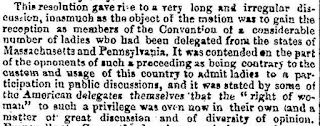
In a debate on whether they should be allowed to attend, several British delegates pointed out that equality for women was against English custom, and that the Americans should respect that. The irony of this argument in an Anti-Slavery Convention was not lost on the visitors. Mr Bradburn remarked during the discussion:
"The invitation was extended to all abolitionists throughout the world; and no doubt it was earnestly desired, as well as designed, that they should all be represented here. [...] But we are now told, that it would be outraging the tastes, habits, customs, and prejudices of the English people, to allow women to sit in this Convention. [...] I depreciate the principle of this objection. In America it would exclude from our Conventions all persons of colour; for there, customs, habits, tastes, prejudices, would be outraged by their admission."
However, those delegates against admitting women made the case that it was not out of disrespect, but was also a practical measure made necessary by public opinion. Admitting women would open the Convention to ridicule.
The debate was wound up when delegates began to complain that such a discussion was preventing more pertinent talks. Samuel Prescod of Barbados insisted that the ladies told him they came here fully aware they would not be received, and that the debate had been improperly forced upon the convention. In turn, he was criticised for using the contents of a private conversation in a public debate.
In the end, the "Garrisonites" lost the vote heavily. The women took their places in the gallery as spectators, and so did Garrison himself, much to the amusement of the British delegates.
And that's how the first international anti-slavery convention started with a discussion about women's rights.
References
TEMPERLEY, H., (1972) “British Anti-Slavery 1833-1870”, Longman, p 85-92
“General Anti Slavery Convention” The Times (London, England), Saturday, Jun 13, 1840; pg. 7
“Proceedings of the General Anti-Slavery Convention”, British And Foreign Anti-Slavery Society, London, 1840, p 24-46
The scene was was the first General Anti-Slavery Convention, organised in 1840 by the British and Foreign Anti-Slavery Society. Invitations to the event were sent out around the world in June 1839. However, this invitation did not specify the gender of the attendees, since the Society in question assumed that everyone would understand it was for men.
However, for the past two years in the United States, women had been pushing for equality in the campaign. These "Garrisonites" (named after a pro-feminist male campaigner) made it clear that they would attend and even ignored a second invitation sent in February 1840 which specified that only "gentlemen" were invited.
When the female delegates arrived, the organisers found themselves in a delicate situation. Their American colleagues were divided on the issue, and to make matters worse, the women were quick to make the most of any affront to their dignity.

In a debate on whether they should be allowed to attend, several British delegates pointed out that equality for women was against English custom, and that the Americans should respect that. The irony of this argument in an Anti-Slavery Convention was not lost on the visitors. Mr Bradburn remarked during the discussion:
"The invitation was extended to all abolitionists throughout the world; and no doubt it was earnestly desired, as well as designed, that they should all be represented here. [...] But we are now told, that it would be outraging the tastes, habits, customs, and prejudices of the English people, to allow women to sit in this Convention. [...] I depreciate the principle of this objection. In America it would exclude from our Conventions all persons of colour; for there, customs, habits, tastes, prejudices, would be outraged by their admission."
However, those delegates against admitting women made the case that it was not out of disrespect, but was also a practical measure made necessary by public opinion. Admitting women would open the Convention to ridicule.
The debate was wound up when delegates began to complain that such a discussion was preventing more pertinent talks. Samuel Prescod of Barbados insisted that the ladies told him they came here fully aware they would not be received, and that the debate had been improperly forced upon the convention. In turn, he was criticised for using the contents of a private conversation in a public debate.
In the end, the "Garrisonites" lost the vote heavily. The women took their places in the gallery as spectators, and so did Garrison himself, much to the amusement of the British delegates.
And that's how the first international anti-slavery convention started with a discussion about women's rights.
References
TEMPERLEY, H., (1972) “British Anti-Slavery 1833-1870”, Longman, p 85-92
“General Anti Slavery Convention” The Times (London, England), Saturday, Jun 13, 1840; pg. 7
“Proceedings of the General Anti-Slavery Convention”, British And Foreign Anti-Slavery Society, London, 1840, p 24-46
Tuesday, 19 February 2013
Life drawing 18/02/13
Actually, two of these are from last week. About a month or so ago, in a typical session, I was happy with a lot of my drawings. I thought that maybe I'd cracked it and was now good at art. In the past few weeks, though, I've slipped right back and now I only produce a couple of good things a week.


On this next one, I was a bit desperate after failing to come up with anything worthwhile all session. So I did the drawing without looking at the paper and then shaded it in as if I'd meant it to be that way. It's a nice way to loosen up, and I think it lead to the last drawing.


On this next one, I was a bit desperate after failing to come up with anything worthwhile all session. So I did the drawing without looking at the paper and then shaded it in as if I'd meant it to be that way. It's a nice way to loosen up, and I think it lead to the last drawing.


Friday, 15 February 2013
Museums that threw away their meteorite collections
Since I'm writing about meteorites, I thought I'd post this up. It's from something I wrote on the JREF forums some years ago.
Several times over the years, I've read the claim that in the late 18th century the scientific establishment so comprehensively rubbished the eye-witness reports of meteorites, that museums across Europe threw out their collections of meteorite specimens. Two examples of this are:
"So great was the prestige of the committee and so convincing its arguments that museums all over Western Europe threw away their meteorite specimens."
Chris Carter, “Parapsychology and the Skeptics”, 2007
“Museums all over Europe had thrown out their cherished meteorite specimens with the rubbish as humiliating reminders of a superstitious past. Today scarcely a single specimen is known that predates 1790, except for the 280-pound stone that fell in Alsace in 1492, that is kept in the town hall of Ensisheim, and that proved too heavy for even the Academie Francaise to dislodge.”
Richard Milton, “Alternative Science: Challenging the Myths of the Scientific Establishment”, 1996
And this claim pops up on the occasional web site as an example of why mainstream science can't be trusted. It was such an interesting claim, that I wanted to find out more.
A reference, when one is given, points us to Paneth, “Science and Miracle”, Durham University Journal, 1949. Keen to find out more about this travesty of science, I paid for a copy of the paper, where I read:
“it is a sad reflection that in those days many public museums threw away whatever they possessed of these precious meteorites; it happened in Germany, Denmark, Switzerland, Italy and Austria.”
So, not quite “all over Europe”, but across five countries. But still quite an event.
Still wanting to know more, I kept searching periodically until recently I found this quote from the book “Cosmic Debris: Meteorites in History”, by John G. Burke (available on Google Books)
From Chapter 6:
“Chladni, in his Uber Feuer-Meteore (1819), decried the fact that some meteorites in collections were discarded in the eighteenth century, terming their removal “Enlightenment vandalism.” These acts, he wrote, occurred at five places: Dresden, Vienna, Copenhagen, Bern and Verone; and they involved meteorites from two sixteenth-century and four seventeenth century falls”
So the claim has changed from a mass deletion of data entailing museums from across Europe, to it happening in just five museums, concerning the collections from six falls. Not so dramatic. Burke goes on to explain that museums didn't really exist in the way we understand them in the late 1700s, and he points out some questionable aspects of these collections, before adding:
“Yet of the twenty seven falls in the eighteenth century that are now considered to have actually occurred, specimens of eighteen (two thirds) still exist in collections.”
So if you do find yourself faced with someone who uses this as an example of how dishonest science is in the face of new data, you can explain to them how it's an example of how lazy new age writers are in chasing up their references.
Several times over the years, I've read the claim that in the late 18th century the scientific establishment so comprehensively rubbished the eye-witness reports of meteorites, that museums across Europe threw out their collections of meteorite specimens. Two examples of this are:
"So great was the prestige of the committee and so convincing its arguments that museums all over Western Europe threw away their meteorite specimens."
Chris Carter, “Parapsychology and the Skeptics”, 2007
“Museums all over Europe had thrown out their cherished meteorite specimens with the rubbish as humiliating reminders of a superstitious past. Today scarcely a single specimen is known that predates 1790, except for the 280-pound stone that fell in Alsace in 1492, that is kept in the town hall of Ensisheim, and that proved too heavy for even the Academie Francaise to dislodge.”
Richard Milton, “Alternative Science: Challenging the Myths of the Scientific Establishment”, 1996
And this claim pops up on the occasional web site as an example of why mainstream science can't be trusted. It was such an interesting claim, that I wanted to find out more.
A reference, when one is given, points us to Paneth, “Science and Miracle”, Durham University Journal, 1949. Keen to find out more about this travesty of science, I paid for a copy of the paper, where I read:
“it is a sad reflection that in those days many public museums threw away whatever they possessed of these precious meteorites; it happened in Germany, Denmark, Switzerland, Italy and Austria.”
So, not quite “all over Europe”, but across five countries. But still quite an event.
Still wanting to know more, I kept searching periodically until recently I found this quote from the book “Cosmic Debris: Meteorites in History”, by John G. Burke (available on Google Books)
From Chapter 6:
“Chladni, in his Uber Feuer-Meteore (1819), decried the fact that some meteorites in collections were discarded in the eighteenth century, terming their removal “Enlightenment vandalism.” These acts, he wrote, occurred at five places: Dresden, Vienna, Copenhagen, Bern and Verone; and they involved meteorites from two sixteenth-century and four seventeenth century falls”
So the claim has changed from a mass deletion of data entailing museums from across Europe, to it happening in just five museums, concerning the collections from six falls. Not so dramatic. Burke goes on to explain that museums didn't really exist in the way we understand them in the late 1700s, and he points out some questionable aspects of these collections, before adding:
“Yet of the twenty seven falls in the eighteenth century that are now considered to have actually occurred, specimens of eighteen (two thirds) still exist in collections.”
So if you do find yourself faced with someone who uses this as an example of how dishonest science is in the face of new data, you can explain to them how it's an example of how lazy new age writers are in chasing up their references.
On meteorites
It is not often that something I'm already researching becomes front page news, but yesterday's dramatic meteor storm over Russia has prompted me to post up this article.
As any textbook will tell you, initial reports of stones falling from the sky were treated as superstitious nonsense. Stones in the sky were considered an impossibility, and most of the witness reports were from ancient history or from the uneducated classes. I was interested to know more about how the theory (that these stones came from outer space) went from instant dismissal to final acceptance.
Throughout the 1700s, meteor sightings were reported in newspapers and scientific journals. However, it was not taken seriously as a field of research until 1792 when a German scientist Ernst Chladni put together a review of all the reports he could find and concluded that they had an extra-terrestrial origin.
This theory, although widely publicised, was not taken seriously. An encyclopaedia entry from 1803 writes about this new theory as if it is an amusing curiosity.
"[A] new and very singular hypothesis has been framed by Professor Chladni of Wittenberg, who maintains it by argument, which, however fanciful, are yet worthy of the reader's notice."
After a lengthy and even-handed explanation of Chladni's ideas, the author ends with a reference to the atheism that had recently spread throughout France after the Revolution.
"Whether Chladni be a philosopher of the French school we know not; but some parts of his theory tend strongly towards materialism; and the arguments by which he attempts to prop those parts are peculiarly weak. [...] but how absurd would it be to say, that the system of general laws, by which the Author and Governor of the universe connects together its various parts, and regulates all their operations, possesses, independently of him, the power to produce worlds and whole systems, to destroy them, and from their materials to form new ones!"
In the years following Chladni's work, an English scientist called Edward Charles Howard managed to obtain samples from various meteorites and concluded that (a) they were all similar in composition and (b) they were all unlike any known terrestrial rock.
In 1818, A System of Chemistry summarises the current arguments:
"Chladni endeavoured to prove that the meteors from which they fell were bodies floating in space, unconnected with any planetary system, attracted by the earth in their progress, and kindled by their rapid motion through the atmosphere. But this opinion is not susceptible of any direct evidence, and can scarcely be believed, one would think, even by Dr. Chladni himself."
Meanwhile, the most supported theory for the origin of meteorites is described as:
"The greater number of philosophers consider them, [...] as concretions actually formed in the atmosphere. This opinion is undoubtedly the most probable of all; but in the present state of our knowledge, it would be absurd to attempt any explanation of the manner in which they are formed."
Interest in meteorites had meant increased observations such that by 1841 Chladni's hypothesis is described as "that which appears to have met with most favour" although the article by Rosina Zornlin lists a number of objections to Chladni's theory.
Finally, in 1864 it appears that Chladni's theory has all but won the day, as Alexander Herschel writes that "Observations of luminous meteors have now divided themselves into three classes, for each of which a separate investigation leads to the uniform result that the hypothesis of Chladni is the only one which bears upon its face the stamp of truth."
A fair amount has been written about the controversy surrounding meteorites, and I may return to this in the future. However, the claim that researching it could end a scientist's career in ridicule doesn't seem to have been the case, since Chladni went on to become even more famous for his work in acoustics.
References:
CHLADNI, E. (1792) "Über den Ursprung der von Pallas gefundenen und anderer ihr ähnlicher Eisenmassen und über einige damit in Verbindung stehende Naturerscheinungen"
HERSCHEL, A. (1864) “The Chemical News and Journal of Physical Science”, Vol.1 (American reprint), Crookes, W. (ed.) p.286
THOMAS, T. (1818) "A System of Chemistry in Four Volumes", vol 3 p160-161
WILKES, J. (ed.) (1810) "Encyclopaedia Londinensis", vol 7, p.386
ZORNLIN, R., (1841) "The London, Edinburgh and Dublin Philosophical Magazine and Journal of Science," Brewster, D., Taylor, R., Phillips, R., Kane, R., Brayley, E.W. (eds.), vol 19, July- December 1841, p547-548
"Supplement to the Encylopaedia, or Dictionary of Arts, Sciences, and Miscellaneous Literature in three volumes", vol 2, 1803, p40-42
As any textbook will tell you, initial reports of stones falling from the sky were treated as superstitious nonsense. Stones in the sky were considered an impossibility, and most of the witness reports were from ancient history or from the uneducated classes. I was interested to know more about how the theory (that these stones came from outer space) went from instant dismissal to final acceptance.
Throughout the 1700s, meteor sightings were reported in newspapers and scientific journals. However, it was not taken seriously as a field of research until 1792 when a German scientist Ernst Chladni put together a review of all the reports he could find and concluded that they had an extra-terrestrial origin.
This theory, although widely publicised, was not taken seriously. An encyclopaedia entry from 1803 writes about this new theory as if it is an amusing curiosity.
"[A] new and very singular hypothesis has been framed by Professor Chladni of Wittenberg, who maintains it by argument, which, however fanciful, are yet worthy of the reader's notice."
After a lengthy and even-handed explanation of Chladni's ideas, the author ends with a reference to the atheism that had recently spread throughout France after the Revolution.
"Whether Chladni be a philosopher of the French school we know not; but some parts of his theory tend strongly towards materialism; and the arguments by which he attempts to prop those parts are peculiarly weak. [...] but how absurd would it be to say, that the system of general laws, by which the Author and Governor of the universe connects together its various parts, and regulates all their operations, possesses, independently of him, the power to produce worlds and whole systems, to destroy them, and from their materials to form new ones!"
 |
| This section taken from an encyclopaedia published in 1810 |
In the years following Chladni's work, an English scientist called Edward Charles Howard managed to obtain samples from various meteorites and concluded that (a) they were all similar in composition and (b) they were all unlike any known terrestrial rock.
In 1818, A System of Chemistry summarises the current arguments:
"Chladni endeavoured to prove that the meteors from which they fell were bodies floating in space, unconnected with any planetary system, attracted by the earth in their progress, and kindled by their rapid motion through the atmosphere. But this opinion is not susceptible of any direct evidence, and can scarcely be believed, one would think, even by Dr. Chladni himself."
Meanwhile, the most supported theory for the origin of meteorites is described as:
"The greater number of philosophers consider them, [...] as concretions actually formed in the atmosphere. This opinion is undoubtedly the most probable of all; but in the present state of our knowledge, it would be absurd to attempt any explanation of the manner in which they are formed."
Interest in meteorites had meant increased observations such that by 1841 Chladni's hypothesis is described as "that which appears to have met with most favour" although the article by Rosina Zornlin lists a number of objections to Chladni's theory.
Finally, in 1864 it appears that Chladni's theory has all but won the day, as Alexander Herschel writes that "Observations of luminous meteors have now divided themselves into three classes, for each of which a separate investigation leads to the uniform result that the hypothesis of Chladni is the only one which bears upon its face the stamp of truth."
A fair amount has been written about the controversy surrounding meteorites, and I may return to this in the future. However, the claim that researching it could end a scientist's career in ridicule doesn't seem to have been the case, since Chladni went on to become even more famous for his work in acoustics.
References:
CHLADNI, E. (1792) "Über den Ursprung der von Pallas gefundenen und anderer ihr ähnlicher Eisenmassen und über einige damit in Verbindung stehende Naturerscheinungen"
HERSCHEL, A. (1864) “The Chemical News and Journal of Physical Science”, Vol.1 (American reprint), Crookes, W. (ed.) p.286
THOMAS, T. (1818) "A System of Chemistry in Four Volumes", vol 3 p160-161
WILKES, J. (ed.) (1810) "Encyclopaedia Londinensis", vol 7, p.386
ZORNLIN, R., (1841) "The London, Edinburgh and Dublin Philosophical Magazine and Journal of Science," Brewster, D., Taylor, R., Phillips, R., Kane, R., Brayley, E.W. (eds.), vol 19, July- December 1841, p547-548
"Supplement to the Encylopaedia, or Dictionary of Arts, Sciences, and Miscellaneous Literature in three volumes", vol 2, 1803, p40-42
Subscribe to:
Posts (Atom)