Friday, 20 September 2013

Finding Japanese streets, after seventy years

Recently I had a small but satisfying episode in which I discovered the location of an old film clip from Japan that I’d been trying to track down for ages.

I first saw the clip about a year ago. It’s a collection of slow tracking shots along various Japanese streets, film sometime in the 40s, after the war. It's quite interesting, especially the bit where a woman says goodbye to her husband and then, after walking a few paces, meets another friend by chance. I decided I would try and find out where it was. I translated a few of the signs, and got as far as working out it was probably in Tokyo, before giving up.

Last week, I found it again, and had another attempt at tracking down the location. I had no luck, so I decided to show it to a Japanese friend. She was able to translate a few more of the signs, including one I had got wrong. She pointed out Hibiya Byouin (Hibiya Hospital) and Tamura Machi (Tamura Town). I took some notes and later that day sat down to try again.

This time I got it down to an area. I found Hibiya Park, but no hospital, and then, by taking some screen shots and zooming in, which meant I found a road sign in English pointing to Shimbashi Station. This, coupled with the fact that a train could be seen passing over a bridge, narrowed the choices down to three or four.

(Shimbashi Station sign top right)

Then I realised that the second clip was actually the same street as the first clip, only with the camera pointing in the other direction. And this time, there was a tram passing by. Suddenly, this became a big clue, but with the tram lines long since removed from streets and no street/tram map from this era online, I was missing the final piece of the jigsaw.

But the other day, just by chance, I was looking through some old maps online. To my surprise I found this site which did have that magical mix of street maps with tram lines. And when I looked at my suspected area, I found a tram line with a station called Tamura Machi right on one of my potential roads. This was the clincher! I'd found it! It was Sotobori Dori, in the Nishishinbashi area, just south of the Imperial Palace.


Of course, nothing is the same, except the width of the road. Everything else has changed since then. Shops, pavements, signs. Even the trees are new. I searched in vain for one thing that survived but I could not.


Sunday, 1 September 2013

More about Signals from Space

A sort-of-sequel to my post about the signals from Mars.

It’s not often that something happens on an internet forum that is worth remarking about to other people, but just today my attention was brought to something that I thought I’d like to share.

Someone posted a link to an article from the National Security Agency Technical Journal which describe how to decipher a number of extra terrestrial messages discussed in a previous issue.


The person from the forum wanted to know if it was true. Well, the site was certainly real, and the article definitely seemed to be talking about messages from outer space. It was hard to believe, but it seemed to be genuine.

I took a look through the list of declassified articles on the site, and soon found the answer. The "extra-terrestrial messages" began in an article where a writer, Lambros D. Callimahos, discussed what a message to an extraterrestrial intelligence might look like: what universal codes could be used.

Following this, the Callimahos offered a few examples as puzzles and then in the next issue Howard H. Champaigne added some more. The article above, that had caused all the confusion about the NSA decoding extraterrestrial messages, was in fact the key to solve the puzzles.

It was interesting to see how a solution page to a puzzle could be so confusing: it was written in a dry style with no indication of its less-than-serious subject and also some joker in the NSA had slipped the word “UFO” into the url. It had me fooled for a while.

References:

Callimahos, L.D. “Communication with Extraterrestrial Intelligence”
Champaigne, H.H. “Extraterrestrial Intelligence”
Champaigne, H.H. “Key to the Extraterrestrial Messages”

Friday, 30 August 2013

The Forgetful Lawyer

The idea of a lawyer who starts arguing against his own case may sound like a character from a bad sitcom, but it occurred at least once in real life. The biography for Lord Eldon relates that when he was young, and simply known as John Scott, he was working as a junior to Mr Dunning (“who was the most eminent of the counsel prectising in the Court of King’s Bench”).

The anecdote, as told by Lord Eldon, goes:

“He began the argument, and appeared to me to be reasoning very powerfully against our client. Waiting till I was quite convinced that he had mistaken for what party he was retained, I then touched his arm, and, upon his turning his head towards me, I whispered to him that he must have misunderstood for whom he was employed, as he was reasoning against our client. He gave me a very rough and rude reprimand for not having sooner set him right,”

Yet Mr Dunning managed to get out of this situation with a very elegant solution...

“[He] then proceeded to state, that what he had addressed to the court was all that could be stated against his client, and that he had put the case as unfavourably as possible against him, in order that the court might see how very satisfactorily the case against him could be answered; and, accordingly, very powerfully answered what he had before stated.”


Reference
Twiss, H. (1844) “The Public and Private Life of Lord Chancellor Eldon” Vol 1, p63

Monday, 26 August 2013

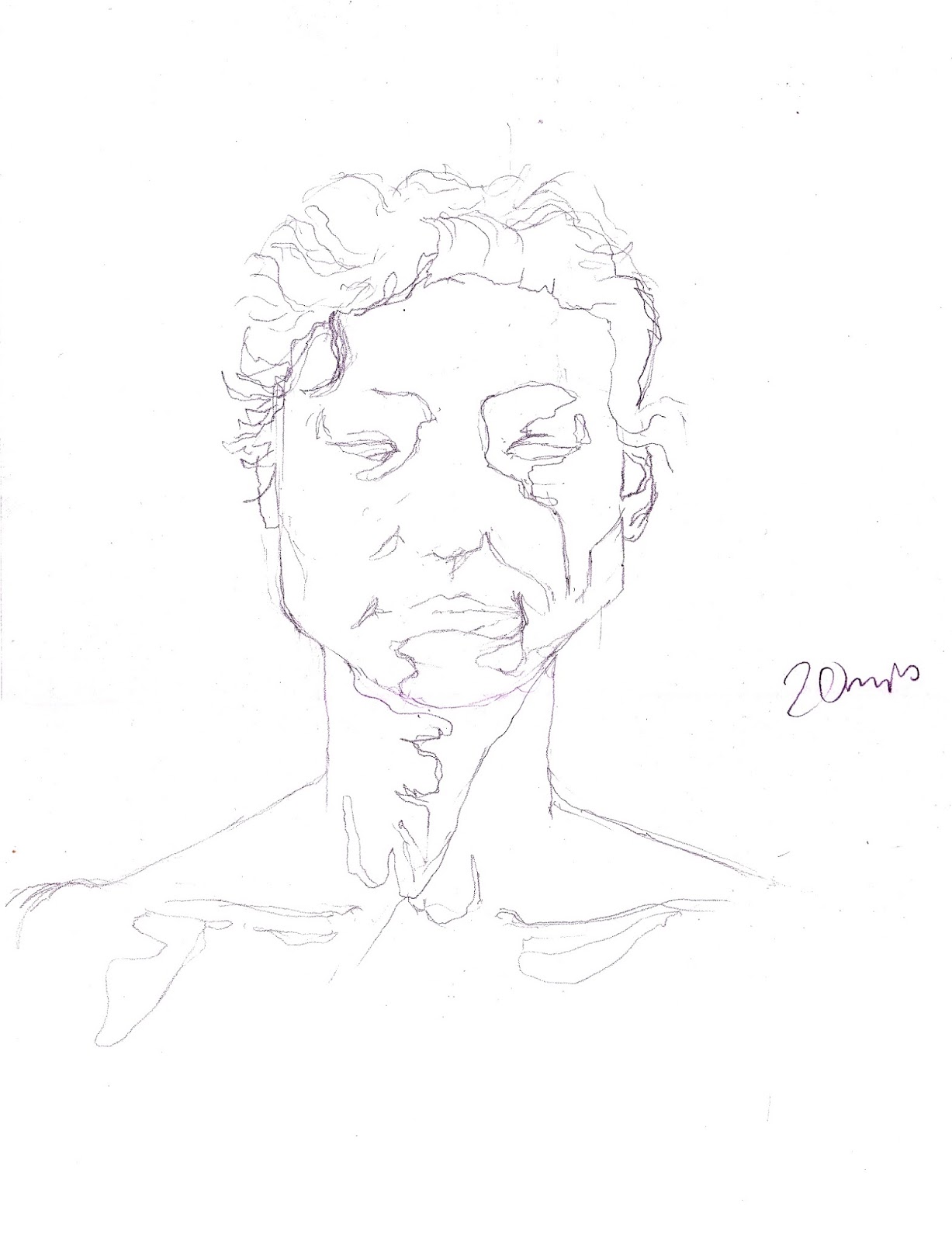
Life drawing 26/08/2013

Although I’m not late, I am usually one of the last to arrive for life drawing, so I’m obliged to take a space at the side. This is fine by me, since the lighting is usually more interesting and, besides, profiles tend to be easier to draw.

Today, since it was a bank holiday, there were fewer people and when I arrived there was one seat at the front, centre stage. Well, I chose it immediately.

I sort of regretted that. Because the model needs to give everyone in the room a decent angle to work from, a lot of the poses were facing forward. In other words, straight at me. I struggled at first with this. I kept telling myself it shouldn’t make a difference, but the lighting and the pose seemed a lot flatter than usual.

The best of a very bad bunch
Finally, in the long fifty minute pose, I was faced with someone doing a sort of lotus pose. I was depressed at first: after a load of drawings with no sense of movement, you couldn’t ask for a more sedate model. But this time, I decided to focus on the symmetry rather than ignore it, and I think it turned out okay.


Thursday, 15 August 2013

Late sun rises and missing satellites

A short-lived but entertaining rumour occurred in October 1736. In the Ipswich Journal for October 15-22, they stated that the “News-letters” for October the 19th reported that the Royal Observatory in Paris had discovered two strange phenomena. One, that the sunrises and sunsets for the past ten days had been quarter of an hour later than expected, and also that one of Jupiter’s satellites had disappeared.


Quite what the implications would have been had this rumour spread is never discovered. After just a week, retractions were being published in those newspapers that carried the initial story.


Where this story came from, a misunderstanding or deliberate misinformation, is never made clear. Pity. It would have been interesting to see the effect if it had been given more time.


References
Ipswich Journal, 15-22 October 1736
Derby Mercury, 28 October 1736