Showing posts with label Remote Viewing. Show all posts

Tuesday, 5 July 2022

Remote viewing the Iranian Hostage Crisis 1979-81

 Background

The Iranian Hostage Crisis began on 4 November 1979 and was initially an anti-US demonstration in the Iranian capital of Tehran. Students, angry at the US agreeing to give medical treatment to the deposed and exiled Shah of Iran, occupied the grounds and buildings of the US Embassy, holding the staff there hostage.


This was not the first such demonstration in Iran that year and, although the US authorities were angry at the situation, it was assumed that it would only last a few days at most. However, when the Ayatollah Khomeni praised the actions of the students, it became something more important and the occupation continued, with 52 hostages being held for 444 days.


The remote viewing project, then called Grill Flame, began work on the hostage crisis within a month and continued to work on it for almost all of the time that Americans were in captivity: the last session is dated 13 January 1981 and the hostages were released one week later.


I wrote a book about the entire crisis called America’s Imaginary Hostage Crisis so if you’re interested in a deep dive into the data, then this is definitely recommended…


But for this blog, I’d like to assess the claims of success that you often see reported in articles or books.


The first is Joe’s recalling of the team being called into a special session on the day the occupation began.


The beginning of the crisis


In the early part of November 1979, I received a call at 4:00 A.M. asking me to report directly to the office [...] So, I arrived not knowing that the American Embassy located in Tehran, Iran, had been invaded by Iranian revolutionaries. It was still dark when all six permanent and part-time remote viewers joined the operations officer, Fred, in the office. He said it was going to sound like a strange request, but that a number of Americans had been taken hostage in a location overseas, and they needed our help in identifying them. He then threw a pile of a more than a hundred photographs onto the tabletop—tell us which are the hostages and which are not. He left the room and left us to the problem.


McMoneagle, Joseph. The Stargate Chronicles: Memoirs of a Psychic Spy: The Remarkable Life of U.S. Government Remote Viewer 001 . Crossroad Press. Kindle Edition. 


Occasionally he recounts this story in talks and presentations, sometimes with the addition that he got it 100% correct.


The story is problematic for a couple of reasons. First, the US authorities knew exactly who was on the US embassy compound at the time the Iranians took over. Indeed, embassy staff in Tehran were calling Washington to keep the US government informed as the Iranians were arriving. Secondly, as mentioned before, this had happened before (in February 1979 the US  Embassy had been occupied in an almost identical event) so the initial reaction to the actions of the students was not one of panic. The US authorities were confident that, after the students had been given some publicity, the Iranian police would move in and clear the compound.


So there’s no reason for an early morning session as described. It doesn’t exist in the declassified articles, nor is it included in lists of sessions or summaries of notable events. So it was either totally unofficial, not even sanctioned by the Grill Flame management, or it didn’t happen at all.


Operation Eagle Claw


Often in articles regarding Grill Flame and the hostage crisis, their role in the operation to rescue the hostages is mentioned. This military plan called Operation Eagle Claw took place in late April 1980, at a time when all of the hostages were still held in the embassy compound.


On 23 April, the remote viewing team were ordered to leave the Fort Meade site, where they were based, and move into three rooms booked in the Best Western Motel. For the next two days they’d run a grueling series of sessions targeted at different parts of the Embassy: twenty sessions in under forty hours.


The army operation taking place in Iran at this time ended in tragedy. Faulty equipment meant the mission was aborted and then, as they were about to return, a sandstorm whipped up and in the ensuing confusion, a helicopter crashed into a plane and eight servicemen died while the rest retreated back to safety.


During the session at the motel, two remote viewers reported seeing something violent. On 24 April at 4pm, Fern described a “quick raid” while describing the Deputy Chief Mission Residence (area I).


“[..] Report the activity as two o’clock in the morning.”

“It’s one of complete mayhem.”

“Tell me what makes you say that.”

“I don’t know.”

“Report the raw imagery to me.”

“People scurrying. Guards scurrying from their cots.”

“Go on.”

“Just a quick impression of a very foreboding quick action.”

“All right. Move in time again one more hour in the future. Three o’clock in the morning. Three o’clock in the morning.”

“I can’t get rid of this imagery of a quick raid.”


Endersby, “America’s Imaginary Hostage Crisis” p98, Kindle


And the second example is often credited to Nancy Stern although it was actually Hartleigh Trent who conducted session CCC84. In her book “Phenomenon” Annie Jacobson writes:


Declassified documents indicate that on April 24, 1980, Nancy S. was conducting Remote Viewing (RV) Session CCC84 when she broke down. The tasker noted, “Admin note 0300 Hours in Iran,” or at 3:00 a.m. local time, Nancy S. reported she was having trouble getting the target she’d been sent to, which was a building in Tehran code-named India. Instead, she said she saw “an attacking force of some kind.” She apologized and stated that perhaps she was “hallucinating.” What she saw was “weird and illogical” but “very vivid, horrible. Like a bad dream…” Her descripion was of “Big chest, big big gorillas. Great big chest beating gorilla leading these apes… they had tiny 9 inch long rockets, hundreds of them.” She apologized again and said she’d “never lost control like this before.” 
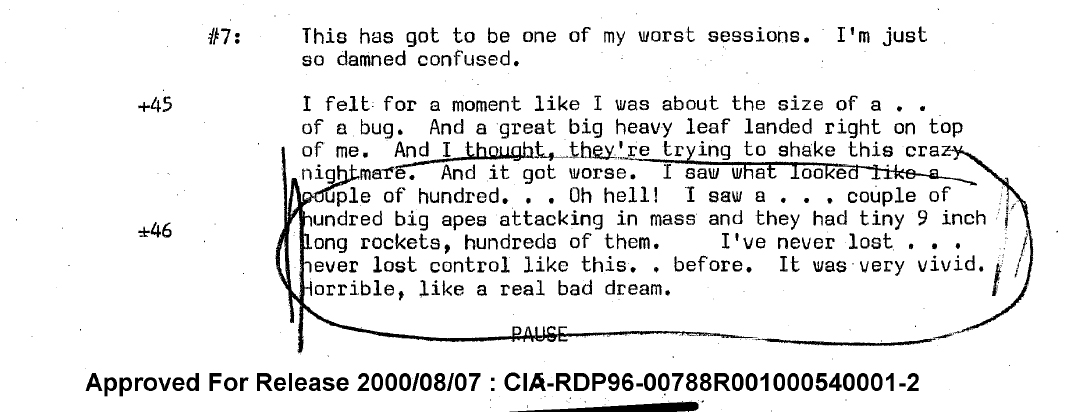


Putting to one side any confusion between Nancy or Hartleigh, the fact is that the remote viewing sessions had twice described violent or disturbing scenes. But this was because they weren’t blind to the target, nor to the aims of Operation Eagle Claw. They’d been fully briefed on the topic and so it is not surprising that scenes of armed exchanges would be reported. It’s worth noting, however, that the US forces retreated long before any chance at engaging with enemy troops could take place.


The news about the tragic end of Operation Eagle Claw broke during two sessions being run simultaneously. Both were cut short as the remote viewing team were brought together to watch the TV news. According to McMoneagle, Nancy was deeply upset at this and, in fact, she soon left the team and would never complete another remote viewing session.


Richard Queen


The next most famous claim concerns Keith Harary’s description of a session he undertook in July 1980.


I received an urgent morning call asking me to report to SRI. I met with a tall, expressionless man who served me a cup of hot coffee before we retired to the white room and got to work.


"We have a person who needs a description," the monitor said, offering me not a clue. Though I hardly understood the process, the question triggered a cascade of impressions about a person in a debilitated state of health. "He seems to be suffering from nausea," I said. "One side of his body seems damaged or hurt." I wondered whether the person I was describing might be some business person or a head of state.


"Where will he be in the next few days?" the monitor asked, again without inflection. I suddenly felt the sensation of sitting on an airplane that was taking off.


"On an airplane," I said.


The target turned out to be the hostage Richard Queen, held by Iranian militants and now desperately ill with multiple sclerosis that affected his nerves on one side. In part due to my input, I was later informed by contacts at SRI, President Carter dispatched a plane to bring Queen home.


https://www.psychologytoday.com/gb/articles/200411/confessions-star-psychic


Keith Harary was working for SRI in July 1980 and he had recently run a number of sessions against the Hostage Crisis. But SRI work focused on the hostages is largely missing from the declassified archives. Any contemporary notes from this particular session targeting Richard Queen are absent, possibly because it wasn’t part of the Grill Flame Project. The first time it is mentioned is in 1983, in an overview of the Grill Flame project when it is listed among a number of “successful viewings for the DoD/intelligence community”. But there are no further details. And Harary himself has issues with how psychic his vision had been.


“Were my impressions psychic? The hostages had been flooding the news for months.


Reports about Queen's health problems, including the issue of "a lame shoulder," had been in the news as well. I don't know whether such reports infiltrated my unconscious without my realizing it, but it would make sense to consider that possibility before the paranormal alternative.

https://www.psychologytoday.com/gb/articles/200411/confessions-star-psychic


Conclusion


Ultimately, the efforts of the remote viewing team were not well-received and a report written after the crisis was over stated:


“Comparison of the reports with returnee debriefings revealed a very low correlation between actual hostage locations/ conditions and inferences drawn from Grill Reporting. Only seven reports could be positively correlated with actual location or condition. Approximately 59

reports revealed a possible or partial correlation.

However, these same reports often included erroneous data. Sixteen reports contained inconclusive data making correlation highly subjective. Eight reports were noted as being poor from an administrative/ procedural standpoint and therefore being of no value. One hundred and twelve reports were found to be entirely incorrect.”


https://archive.org/details/CIA-RDP96-00788R001000340002-3


So, how much of the data produced by Grill Flame was used operationally? None. The  entire project had been for training purposes, something that the remote viewers were not aware of. But by now, despite the results, Grill Flame had other projects to work on and it seems that simply being involved in the Hostage Crisis had raised its profile and secured its funding for another few years, at least.


Monday, 2 May 2022

Remote Viewing the hostage LTC William Higgins 1988-1989

 The Lebanon Hostage Crisis lasted for a ten-year span of time in which foreign officials would be abducted in Lebanon by various Islamic groups for the purposes of ransoms or publicity for a cause or bargaining for a prisoner to be released. It began in 1982 with the disappearance of four Iranian diplomats and ended with the release of two German relief workers in the summer of 1992.
Of the many US citizens taken hostage, the remote viewing team focused mostly on LTC William Higgins. He was kidnapped on 17th February 1988 neat the city of Tyre in south Lebanon and he died in captivity, killed by his captors at an unspecified time. At no point was his location identified and out of all the hostages, his is the one case with least information to go on.

The project to try and locate Higgins continued for months. Over one hundred sessions were targeted at this kidnap victim. Trying to trace some kind of narrative through this is difficult, especially given that we know almost nothing about what actually happened to Higgins: the place he was held or how he died. These details are either still a mystery or classified.

Three anecdotes regarding this episode are worth quoting from. Lyn Buchanan relates his memory of remote viewing his murder during a session with Higgins as the target.

“One of the last hostage crises we dealt with was the abduction of Col Rich Higgins, who was yanked from his United Nations jeep and kidnapped in 1988 by Iranian-backed Hezbollah terrorists in Lebanon. As a unit, we tracked his condition and situation for months.

One day, I was in the middle of a session when I was startled by an extremely strong impression: "RASAIN." "Where did that come from?" I asked myself. Knowing that you write down every impression that you get in session, I dutifully scribbled, and continued my session.

Not thinking about the sudden impression, I wrote up my report on the colonel's condition and a description of his immediate surroundings. I turned the session in and went home for the day.

A few days later, given the same task, I found Colonel Higgins standing in an outdoor location. He was on the slight slope of a sandy embankment. Then, suddenly, he was on the ground, head downwards on the slope, face down in the sand, dead. Some men with guns were walking away from the body, laughing and joking with one another. I reported my findings, and three other viewers were immediately tasked with his condition and situation, in order to confirm or disprove my findings. The other three viewers found him to be quite alive. But I was certain of what I had found. The next day we got the report that the Hezbollah had sent pictures of the colonel's dead body overnight. During that session I had evidently witnessed his execution. There was no joy in being right this time.”


Next is this except from an article “An Interview with Angela Ford” in the remote viewing magazine, Eight Martinis, issue 14

“Angela initially placed him physically in a specific spot on the map, and advised that he was being held in a building at that exact location. Unfortunately, photos of that specific location indicated that it was nothing but open and bare ground. No building. So the reaction by Dames and others to Angela’s initial effort was a smirk. Later, a released hostage who spent time with Higgins in captivity reported that Angela was absolutely right on the money. The photos which supported the psychics’ effort was outdated – old. In fact, Higgins had been held in a specially constructed shed in the exact location designated by Angela. Photographs might have revealed the building, if current photos had been used to support the psychics’ efforts.”


Third is this paragraph from Jim Schnabel’s 1997 book “Remote Viewers: The Secret History of America’s Physic Spies”

“In February 1988, a senior U.S. Marine Officer, Lieutenant Colonel William Higgins, was kidna[[ed from Beirut by the Islamic terrorist group Hezbollah. DT-S was asked to try and find him. Ed Dames, running a team of CRVers, came up with a description of a house where it seemed that Higgins was being held in South Lebanon. Angela Dellafiora, front-loaded with reconnaissance photographs of the area and monitored by Fern Gauvin, picked out instead a certain field near a road; she believed that Higgins was being held underground there, somehow. Several days later, the CRVers began to report that Higgins was dead. Angela reported that he was alive, and would soon be released. Both sets of data were sent downtown, but of course they conflicted, and were probably ignored.”


Going through the archive day by day, a slightly different narrative emerges.

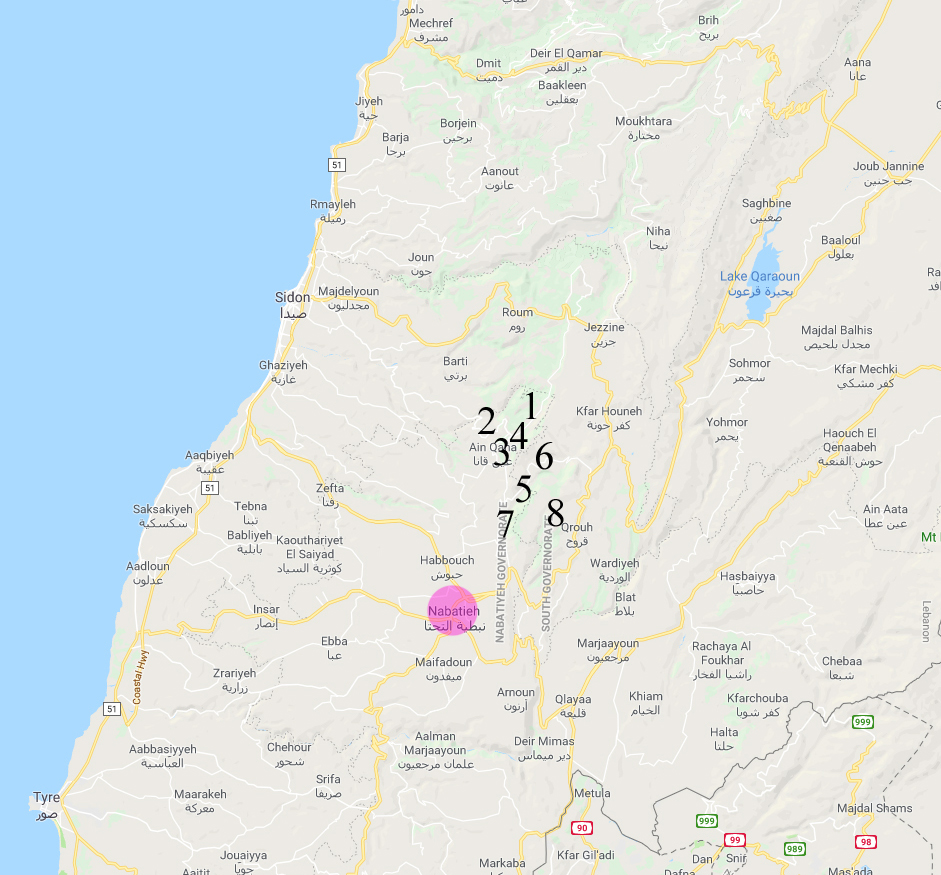
On 18th February, the day after the abduction, the five remote viewers (Mel R, Angela D, Paul S, Lyn B and Gabrielle P) record their initial impressions. Oddly, this is the time when Lyn sees the word “Raisan” as described above. But in the story according to his book, a few days later he saw the execution of Higgins whereas in reality that session wouldn’t happen for over a year. Paul said Higgins was “Surrounded by land. Hills, valleys, farming” and Angela got the phrase “Bladd-ish” or “Blabd-ish.”

Map showing approx locations of predictions made on 18th February 1988

These were all in the southern part of Lebanon near the area he went missing. Interestingly, on the 22nd, the Lebanese radio station Voice of the Nation reported that, according to Hezbollah, Higgins had been moved out of the south of the country. Coincidence or not, future sessions placed Higgins’ location further north.

On the 25th Paul did a dowsing session, pin-pointing three locations, two of which were in the sea. The following day, he placed Higgins 20 miles SW of Lake Qaraoun. On the 4th of March both Lyn and Mel give sessions that locate him in a quarry. A couple of weeks later, different viewers give his location as South Beirut, Blazdah or Nabatieh.

In mid-March Angela made predictions of all of the hostages locations. I believe this session is the source of the “empty field” prediction mentioned twice in the anecdotes above. It appears that these locations were very close to where US intelligence believed Higgins was being held: the village of Arab Salim. 

Angela's predictions of hostage locations (numbers taken from declassified report)

As such, the DIA arranged a follow up session in which Angela (and two other RVers) was told to focus on that area. In the typed notes, the area she chose is labeled “Y” with the note that “(Y appears to be an open field).” However, Angela predicts his imminent move to another area. The next time she specifies an area for Higgins, it is a long way from Arab Salim.

The grey circle shows the approx location where the DIA thought Higgins might be

It’s also around this time that Angela starts to predict his release: she said 22nd April in mid-April, then in May this changed to “the near future” and “prior to 13 June 1988” and then at the end of June the prediction became late July or early August.

In fact, Angela seemed very invested in this case. She continued to target him in sessions long after the rest of the team had stopped. Indeed, apart from a flurry of team activity in January 1989, she is the only one working on Higgins between August 1988 and the news of his death in late July 1989.

On 21st April 1988, a photo of Higgins in captivity was released by his captors and after that, what happened to him remains a secret. In May, the DIA asked the RV team if Higgins was still alive. All of the sessions report him as living.

Photo of Higgins released 21st April 1989

Then, in May, came a number of sessions that all seemed to point to Higgins being in the sea. Looking at media reports on the hostage crisis leading up to this time, I can’t find any reason why this might be. Nevertheless, it’s a curious chapter that’s worth mentioning. On 18th, Lyn tries dowsing and gets two locations: one between Beirut and its airport and the other in the sea. The next day, Angela says Higgins is in a rowboat and on the 21st Gabrielle says he’s on a vessel, Lyn says it's a fishing boat and Angela calls it a skiff.

Whatever the reason for this, after a two week break, when the team reconvene, Higgins is no longer at sea. In June and July only Mel and Angela work on this target. Mel puts Higgins in South Beirut while Angela continues to cast her net much further field: Anan, Ayn Nub, Beirut Airport, Bsaba, Khadah are all mentioned.

After this, only Angela continues this project. Most of these session notes aren’t in the archive and one wonders if these sessions were officially requested or something Angela felt compelled to do. Looking at the list of sessions completed at a time when the intelligence services had all but given up on Higgins it resembles a vigil, to be honest, and I’m impressed at the dedication shown by Angela during these months.

Finally, on 31st July, a video showing Higgins’ dead body was released to CNN. On the week commencing 2nd August, three weeks since Angela’s last session about him, the team as a whole was asked to determine if Higgins was alive or dead.

On that day, Angela doesn’t answer that question and still can’t during another session the following day. Another remote viewer, Robin, said Higgins was alive and that wasn’t his body in the video. Lyn’s session is dated 4th August and his tasking is for the location where Higgins was last alive. Oddly, despite his later claim to have seen his execution on the 30th July, here he says Higgins’ date of death was 1st August: the day after the video was released. This clearly contradicts Buchanan's story about remote viewing Higgins’ execution. The final session on this project is dated 15th August 1989 and in it Robin still maintains that Higgins is alive.

In truth, although his captors said they’d executed him in revenge for the kidnapping by Israel of the imam Sheik Obied, Higgins had actually died long before his body was used in the video. His body was finally recovered in 1991, found in the streets of Beirut. The reason for death and his physical state have never been made public.

The remote viewing team clearly had little success on this project and the anecdotes that claim some kind of accuracy rely on reporting only the best guess, or inventing a best guess entirely, and also by changing the time involved from almost a year to just a few days. Below is a map of the predictions by the team that I can specify a location for, up to the summer of 1988.


Sunday, 13 October 2019

Remote viewing a crashed aircraft in Zaire/DR Congo 1979

One of the earliest examples of an operational success claimed by the US Government sponsored remote viewing team was that of the location of an airplane that had crashed in the African jungle in a country then called Zaire, now known as the Democratic Republic of Congo.

A recent commentator on this blog asked me about it and I finally decided to sit down and put together what I had on the subject. This is not meant as any definitive summary of events, merely a collection of what I have so far. Hopefully, over time, other people can fill in a few gaps.

First hand documentation on this is sparse since it dates from the very earliest days of the project, before the military team of remote viewers had been put together. The only contemporary document I can find about this is a memo in the Star Gate Archive and it reads:

The Acting Chief/AF summarized a recent interesting case in which an Air Force “sensitive” individual may have aided in the location of a plane which crashed in Africa after its crew members bailed out. Following intensive and unsuccessful efforts to locate the plane wreckage by other means, the “sensitive” was contacted by the Air Force and after a vision provided coordinates, the name of the country, and a description of the terrain in which the plane crashed. Acting upon this information, the Air Force has located an area corresponding to that described by the “sensitive” and is investigating what appears to be a crash site.

The memo was dated 28 March 1979 and the final sentence seems to imply that the search was still ongoing when the meeting was held. The way the memo talks about a “sensitive” contacted by the Air Force indicates that it wasn’t from the SRI remote viewing program run by Targ and Puthoff but was instead connected to another remote viewing project, Project Have Star, that was being run by Dale Graff in the Air Force. It also implies that the aircraft was American since it states that the crew bailed out before the crash. If it had been a Soviet craft, they probably wouldn't have known the fate of the crew [Note: in the comments below my attention is drawn to a source that identifies the pilot as Libyan].

Years later, former US President Jimmy Carter told an audience of students about this episode in 1995 in reply to a question about the existence of extraterrestrials. He went into a little more detail in his recent autobiography, A Full Life.

One morning I had a report from the CIA that a small twin-engine plane had gone down somewhere in Zaire, and that it contained some important secret documents. We were searching for the crash site using satellite photography and some other surreptitious high-altitude overflights, but with no success. With some hesitancy, a CIA agent in California recommended the services of a clairvoyant, who was then consulted. She wrote down a latitude and longitude, which proved to be accurate, and several days later I saw shown a photograph of the plane, totally destroyed and in a remote area. Without notifying Zaire’s President Mobutu, we sent in a small team that recovered the documents and the bodies of the plane’s occupants.

This account suggests that the plane is American (or else how would the CIA know what it contained) and that it was the CIA, not the Air Force, that contacted the psychic.

Other accounts state that the plane was a Soviet craft, specifically a Tupolev Tu-22 bomber. Schnabel wrote in 1997 that both Gary Langford from the SRI team and “Frances Bryan”, working with Dale Graff, worked on this target and that it was the combination of data from the two that lead the search party to the crash site.

In Paul Smith’s book, Reading the Enemy’s Mind, the psychic that Dale Graff worked with is identified as Rosemary Smith, and dates the crash to March 1979.

Though she was only shown a picture of a typical Blinder and told it was down “somewhere in Africa,” her description and hand-sketched map of the crash site closely matched an area where U.S. intelligence assets were not searching. As those assets were being shifted towards the indicated area, she was handed a topographic map and asked to circle the general location, and mark an X where she thought the crash was.

Joe McMoneagle also wrote about this, except in his account it is the military remote viewers and one psychic from SRI who worked on the target.

Mel, Ken, and I placed the aircraft in a specific area of Zaire, our three locations overlapping a thirteen-kilometer circle. A location given by one of the remote viewers from SRI also put it within that circle. Search teams were sent into the area and the plane was located within a kilometer of the location given by the SRI remote viewer. All locations were within eight kilometers of the crash site. Search teams on the ground said as soon as they entered the circled area on the map they began encountering natives on the trail carrying pieces of the wreck to use in the construction or reinforcement of their village huts.

However, in March 1979, the Grill Flame team had just begun training and were using local targets. They wouldn’t begin on anything resembling an “operational” target until September of that year. It seems likely to me that McMoneagle is misremembering other search missions for airplanes he undertook and has mixed in elements from this particular mission based on other accounts that he had heard.

Dale Graff himself spoke about this event for the film Third Eye Spies. In it, he shows two documents to the camera that do not appear to be in the declassified Star Gate Archive. The first is apparently the sketch produced by Rosemary Smith but it doesn’t look like a forty year old piece of paper and, with no serial number, date or official stamp, I suspect it may be a reproduction, possibly solely for the purposes of the film.


He also had a photocopy of a map that resembles those in the Star Gate Archives, but I cannot find it among those documents. It has red ink which would indicate that it’s either a colour photocopy (and, as such, would probably not be part of the entirely monochrome Star Gate Archives) or it’s a photocopy that someone has drawn over. Again, we have to be open to the idea that this might be a prop for the film, created for illustrative purposes.


However, if we take this photocopy at face value it tells us that the plane crashed near Lake Kivu in the east of the country. If these documents are genuine or are an accurate reconstruction of genuine documents, then it still poses a few questions: if the circle and dot is the crash site, then what are the arrows? Is that where the psychic said to look, or is it where the search party were already looking?

My attempt at putting the red marks from the photocopy
onto Google Maps for the region

Most frustrating is the lack of any corroborating documents from other sources: no mention of a crash in Zaire in early 1979 in any contemporary newspapers nor lists of aviation crashes. This is perhaps not surprising since the aircraft, whether it was American or Soviet, was clearly a spy plane so these events would have been classified at the time [Note: as per the comments below, it could have been Libyan and not a spy plane at all]. Sadly, it appears that it remains that way today.

In conclusion, we have a story of a successful remote viewing session backed up by one contemporary document and a statement from a former US President. The details of the psychic prediction and of the circumstances surrounding the plane itself remain unknown.


References:

Carter, Jimmy. (2015) A Full Life: Reflections At Ninety. Simon & Schuster, New Nork

Third Eye Spies (2019) dir. Lance Mungia. USA, Conscious Universe Films

McMoneagle, Joseph. (2013) The Stargate Chronicles: Memoirs of a Psychic Spy: The Remarkable Life of U.S. Government Remote Viewer 001 Crossroad Press. Kindle Edition.

Shnabel, Jim. (1997) Remote Viewers: The Secret History of America’s Psychic Spies. Dell Publishing, New York.

Smith, Paul. (2005) Reading the Enemy's Mind: Inside Star Gate: America's Psychic Espionage Program,p. 97. Tom Doherty Associates. Kindle Edition.

Sunday, 8 September 2019

Remote viewing the Stealth Bomber, August 1987

It has been claimed that the Remote Viewing project sponsored by the US Government from 1974-1995 scored a notable success when asked to try to perceive the Northrup B-2 Stealth Bomber which was currently in development behind a curtain of absolute secrecy (although its existence was known to the general public, no details were widely circulated).

In the book Remote Viewers by Jim Schnabel, there is a brief description of Mel Riley’s success with this target. Jim writes about “Riley’s sharply detailed sketches” and that the Air Force were so concerned with the accuracy that they ordered that no one else try to remote view this target. [1]

Paul Smith goes into more detail in his book Reading The Enemy’s Mind, quoting Fred Atwater, the project manager, on the sessions.

If I recall correctly, the first targeting was a set of coordinates, and we came back with an aircraft. And Mel’s now-famous drawings. When the first drawings came back, I showed them to the outside analyst, and I said, “Well, it looks like we’re looking at some kind of aircraft, but this is really weird. Please forgive the remote viewers, because sometimes they don’t draw accurately.” And the guy says, “No, I think this is the right aircraft you’re looking at.” [2]

Paul Smith illustrates this with a comparison of sketches by Mel Riley and himself next to photographs of the target, the B-2 bomber, as well as another combat aircraft, the Lockheed F-117 which was not the target of the sessions. [2] [3]

From Paul Smith's book, "Reading the Enemy's Mind"

From an online parapsychology course, 2015

Accounts usually give the impression of a bare minimum of sessions completed in order to get the reported results. However, the project (code number 8709) included four remote viewers supplying 31 sessions. Additionally, the blinding of the viewers to the target was highly suspect and there is evidence in the notes of some pretty overt leading questions. Further complicating matters, at least at the start, was the fact that another project (8711) was still underway. [4] Project 8711 was targeted at Iran and, specifically, an underground missile store. It had been running for two weeks and this may have caused some imagery to cross over. [5]

Project 8709 began on Thursday 30 July 1987, with a session with Mel Riley that did not get any relevant images. The second session was over a week later (10 August) with Lyn Buchanan and, given only encrypted coordinates, he started talking about an airport and was told he had acquired the target when he described the whine of jet engines.

Clearly, the interviewer was not blind to the target and gave cues to each of the four remote viewers on this project. For example, Angela Dellafiore began well: With only encrypted coordinates she described something that flies that was very technologically advanced. In her second session, the interviewer asked multiple times what was so secret about this object. She didn’t give a satisfactory answer and when her third session began she was instructed to talk about the “secret aircraft,” effectively telling her the target of the session.

A collection of sketches from various session notes

Mel Riley struggled early on with this project. His first two sessions were not successful but he had mentioned a “pointed object” which the interviewer told him to focus on in the third session. By now (19 August) Lyn Buchanan had been told that the target was a jet plane and Angela knew that the target flew, so Mel’s immediate description of a plane is an interesting development. Had he overheard something about this project in conversation between sessions? Very early in session three Mel mentioned the SR-71 and was then told that he had acquired the target.

Mel's "pointed object" that, in the following session, became an aircraft

Mel Riley's sketches from 19 Aug

Paul’s first session was on the 12 August 1987. His initial response was to describe a desert area with bivouacs. Even though he had been told explicitly that this was a new project he hadn’t targeted before, there seems to be some overlap with Project 8711 for which he’d already done three sessions in that month. On the other hand, that description could fit the area of the United States where the B-2 bomber was being tested, so his second session began with instructions to concentrate on the “object of special interest located at the bivouac area described in the previous session.”

Paul began by describing and sketching a rocket (“reminds me of a cruise missile”). As the session went on, the interviewer became more active in steering Paul in a certain direction. There isn’t a full transcript but the notes list a number of statements given by the interviewer that have the clear purpose of changing Paul’s rocket into a plane: “In an earlier drawing you started to add “side images” or projections and in this drawing you seemed to have started that again.” The interviewer’s interest in these “side images” reached a peak later on where, in succession, he says to Paul:

“Let’s objectify the term projections. You repeat that phrase frequently.”

“Add the wings to your sketch.”

“Does it bother you if it turns into an airplane”


This is the most overt example of leading a remote viewer that I’ve seen in the entire Star Gate Archive and, if this weren’t enough, at the beginning of his fourth session Paul is told to focus on the “unusually configured aircraft.”

This fourth session took place on 20 August 1987 and, by now, each of the four remote viewers knew that the target was a secret jet aircraft. The sketches used to illustrate how accurate Paul Smith was in describing the Stealth bomber (as shown at the start of this blog) date from this session.

Paul Smith's sketch from his fifth session, on 24 Aug

Finally, although the Northrup B-2 was still shrouded in absolute secrecy at this point, Paul Smith appears to have been influenced by another previous attempt at guessing the appearance of the Lockheed F-117 fighter. In July 1986 a toy company, Testor Corp., released their imagining of the F-117 based on what was known in the public domain and basing it on the Lockheed SR-71. The model, which I recall gained quite a lot of publicity at the time, bears certain similarities to Paul’s later sketches and may have acted as a subconscious cue to the remote viewer.

Paul Smith's sketch and the Testor Corp. model [6]

In summary, the sketches illustrating the efficacy of remote viewing were selected from a much larger pool of sessions and were drawn after the remote viewer was no longer blind to the target.


[1] Shnabel, Jim. (1997) Remote Viewers: The Secret History of America’s Psychic Spies (pp. 51-52) Dell Publishing, New York. (NB, Jim also writes that Joe McMoneagle did a session against this target but, if this is true, it must have been an informal session since Joe McMoneagle had retired from the project several years earlier. No session notes or any mention of sessions with any non-project viewers is present in the declassified documents.)

[2] Smith, Paul. H. (2005) Reading the Enemy's Mind: Inside Star Gate: America's Psychic Espionage Program (p. 371). Tom Doherty Associates. Kindle Edition.

[3], Smith, Paul. H. (2015) Remote Viewing: Antecedents, Conditions, People, Protocols, Applications, Parapsychology and Anomalistic Psychology: Research and Education Massive Open Online Course, http://the-azire.wiziq.com/course/86144-parapsychology-and-anomalistic-psychology-research-and-education, Saturday, February 7th, 2015

[4] Just to complicate matters, Project 8709 had two phases. The first was to remotely view the B-2 bomber and the second was to then attempt to remote view any Soviet counterpart currently being developed. The existence of a Russian stealth bomber had long been considered (and a reduced-radar aircraft, the Tupolev Tu-160, had just gone into service in April of that year) and the B-2 was used as a kind of calibration target to make sure the remote viewers were "online" before they attempted the Soviet target. However, phase two didn't begin until the later stages of the project and so for the sake of simplicity I have skimmed over this detail, except to note that Mel's sketch (21 Aug) and Paul's second sketch (24 Aug) are both from sessions targeted at the Soviet craft, not the American one.

[5] Usually, the use of different encrypted coordinates given to the remote viewer at the start of a session would be enough to inform them that they were working on a new target. However, Project 8711 had used two sets of encrypted coordinates and so a new set might not have had the usual effect of removing the remote viewers' preconceived ideas about the target.

[6] photographs of model taken from Popular Science, September 1986, p79

Sunday, 7 October 2018

Russell Targ remote views San Andres Airport, 1974

Russell Targ’s only formal remote viewing experiment as a remote viewer is a well-known example of psychic functioning, and was recently featured in the article about him on the Society for Psychical Research’s Psi Encyclopedia. However, very little is known about it: it was conducted at the Stanford Research Institute (SRI) during the time when Targ and Puthoff were being funded by the CIA. As such, there was a considerable amount of secrecy surrounding this work.

Furthermore, this experiment has never been written up in any real detail, neither for peer-reviewed publication nor internal memo for the CIA. Instead, details about it are scattered across several different sources. I thought it’d be worth putting together as much information as possible to give a little more context to this remarkable event.


What was the purpose of the experiment?

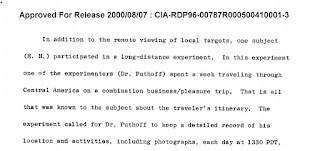
This was a long-range remote viewing experiment, with Hal Puthoff acting as the beacon. He went on a business/pleasure trip to Costa Rica in April 1974. The trip lasted ten days and “a week of remote target viewing” was carried out, with each session taking place at 1330 PDT (1430 CST, the time zone in Costa Rica) at which point Hal would take notes of his current location, including taking photographs.

The experiment was first mentioned in Progress Report No. 2, which is dated 24th April 1974. This is actually a week or so after the sessions were complete, but it’s clear that the report was written some time before publication.


How many sessions was the experiment designed to last?

Seven sessions, taking place in consecutive daily sessions.


Who were the remote viewers?

There were two remote viewers, Pat Price and Hella Hammid, with Russell Targ filling in for an absent remote viewer on one day.

In the book Mind Reach, Targ and Puthoff state that one was in Los Angeles and the other in Menlo Park (ie, at SRI). They did not specify which one was which, but it is more likely that Hella Hammid worked from Los Angeles while Pat Price was at SRI.

However, according to Targ and Puthoff’s 1974 paper “Remote Viewing of Natural Targets,” Hella Hammid was the only remote viewer on this project. Pat Price, despite being mentioned in other parts of the same paper, has been removed entirely from this version of events.


Were the remote viewers blind to the target?

Not completely. In Progress Report No. 3 we learn that the two remote viewers were told that the beacon was Hal Puthoff and he was travelling in Costa Rica.


Which remote viewer did not arrive for the session?

In Targ and Katra’s book Miracles of Mind, it is Pat Price who is absent. However, it is troubling how much Targ’s 1998 version of events differs from the classified documentation. According to this book, the experiment took place in April 1973 (it should be April 1974. In fact, Pat Price hadn’t even joined the team in April 1973) and each session happened at 9.00am (not half past one in the afternoon).

And, of course, in the 1974 paper which removed Pat Price from proceedings, Hella Hammid is named as the psychic who did not turn up.

However, it appears that neither attended. The classified report “Perceptual Augmentation Techniques: Part Two” states that the experimenter “acted as a subject in one experiment on a day in which S4 [ie, Hella Hammid] was not available and the other subject arrived late.” Bearing in mind the quote from Mind Reach telling us that Hella Hammid was based in Los Angeles, if we consider the use of the phrase “not available” it seems to me that Targ already knew Hammid couldn’t submit a session for that day and so when Pat Price did not arrive in time on Friday, Russell Targ submitted his own remote viewing session rather than have one day with no remote viewing data at all.


Was the experimenter blind to the target?

Varous accounts talk about keeping Hal Puthoff's itinerary a secret from the subjects, but there's no mention of doing the same for the experimenter Russell Targ. In Progress Report No.2, when the experiment is first described, it says that the experimenter would also attempt to blind match the session transcripts to the beacon’s target pictures after Puthoff had returned. However, no attempt to complete this part of the protocol was made. Does this mean that Russell Targ had become non-blind to the targets before the judging process could take place? How long was the gap between Puthoff’s return and the photographs being developed? Targ and Katra’s book states “several weeks” but, given the many inaccuracies in that version of events, one has to wonder if this is another mistake.


What happened on the day that Russell Targ did his remote viewing session?

Friday 12 April 1974 was Good Friday that year.

In a recent presentation about his work at SRI, Hal Puthoff explained how he “had a chance to trick” the remote viewers by jumping on a plane and flying to a nearby Colombian island in time for the session. An online airline timetable archive has a LACSA timetable for 1973 which, if we assume that airline timetables don’t change drastically from year to year, confirms that there was a service from Costa Rica to San Andres, Colombia on Fridays (another LACSA timetable dated 1979 has the Friday service still listed). Hal Puthoff would’ve taken the flight from San Jose Airport in Costa Rica to San Andres Airport, but would’ve had to have taken the next flight back or remain there until Monday, meaning he was only on the island for about an hour.

Despite Targ and Puthoff supplying contradictory reports in different accounts, we can be pretty sure that it was Pat Price who did not arrive on time at SRI that day. During these early days in the project, they were still assuming that remote viewing happened in real-time: moving the remote viewer’s perception through the past or the future had not yet been attempted. As such, Pat Price’s absence at that specific time was a problem. Russell Targ has since described his decision to submit a session himself as being done in a spirit of “the show must go on.” Russell Targ’s sketch is dated 4/12/73 (getting the year wrong) and it lasted from 1:25-1:30.


What were the results of the experiment?

Twelve remote viewing sessions were completed: Six by Pat Price, five by Hella Hammid and one by Russell Targ. On his return, Hal Puthoff correctly matched five of these twelve sessions to his seven daily reports, two for Price, two for Hammid and Targ’s session, at odds of 50 to 1 (we shall assume that the notes were given to him with the dates removed).

The content of the sessions by Price and Hammid is largely unknown, except for brief mentions of descriptions of Puthoff relaxing by a pool, in his hotel room or in a jungle environment near a flat-topped mountain (this last session has been credited to both Price and Hammid in different accounts).

The photo that usually accompanies Russell Targ’s sketch is not the same photo that Puthoff took. His two photos were taken from the ground. The aerial photo doesn’t appear until 1977, in the book Mind Reach.


The response to this result was positive, but guarded. An anonymous review of the SRI work to date written in 1975 points out that the full data had still not been submitted, and so any definitive conclusion could not be drawn.


References:

Progress Report No. 2: Perceptual Augmentation Techniques, CIA-RDP96-00791R000200040004-9

Review of Perceptual Augmentation Techniques, CIA-RDP96-00787R000200150004-2

Perceptual Augmentation Techniques: Part Two – Research Report, CIA-RDP96-00791R000300030004-9

Karen Wehrstein (2018). ‘Russell Targ’. Psi Encyclopedia.. Retrieved 6 October 2018.

Targ, R., Katra, J. (1999) Miracles of Mind: Exploring Nonlocal Consciousness and Spiritual Healing,” New World Library, Ca, USA.

Targ, R., Puthoff, H. (1974).  Remote Viewing of Natural Targets. Conference on Quantum Physics and Parapsychology, Geneva, Switzerland, August 26-27, 1974.

Targ, R., Puthoff, H., (1977) “Mind Reach: Scientists Look at Psychic Ability,” Delacorte Press

Dr. Hal Puthoff, PhD, on CIA History of Top Secret Remote Viewing

Sunday, 2 September 2018

A Review of “The Star Gate Archives. Volume 1: Remote Viewing”

This book, “The Star Gate Archives. Volume 1: Remote Viewing, 1972-1984: Reports of the United States Government Sponsored Psi Program, 1972-1995” was compiled and edited by Edwin C. May and Sonali Bhatt Marwaha and published by McFarland in 2018. It is the first of four volumes from May and Marwaha covering the US government sponsored program investigating remote viewing as an intelligence gathering tool. Future volumes will cover Remote Viewing from 1984-1995, Psychokinesis and Reports on Operational Remote Viewing.

This first volume contains reports written by those working at SRI during the first half of the program, predominantly Hal Puthoff and Russell Targ. They are neatly formatted and constitute the least redacted versions of these reports that exist. The most notable example of this is the 1983 report Project Grill Flame: Operational Tasks which I have only ever seen before in a heavily censored form, with entire pages missing, but is now available in all its glory.

The reports are ordered chronologically, which helps give the reader some sense of progression but one should be aware that this is not a history of the project. There are no engaging characters or dramatised versions of events to capture your imagination. It is all quite dry and matter-of-fact in its presentation but this is to its benefit. As there is no attempt at making things seem astonishing and breathlessly exciting, the reader is left to draw their own conclusions from the undoubtedly similar examples of drawings and target photographs. Without the prompting of a narrator, these conclusions seem all the more impressive.

But the reader needs to tread carefully and bear in mind that these reports were written not just to show the efficacy of remote viewing, but also to secure funding. As such, there are no dissenting opinions. Every report is from SRI and only SRI, and so the more critical documents that one finds in the Star Gate Archive are entirely absent [1].

Even taking into account the SRI-only nature of the source, there are still some disappointing gaps in the book. Keith Harary’s apparently successful prediction of the release of hostage Richard Queen is mentioned in passing, but there are no detailed documents on the session. Perhaps they’ve been lost or perhaps they’ll be in Volume 4. The 60-trial experiment done with Uri Geller is also not included, apart from the sparse one-paragraph description of it in the paper published in Nature magazine. (Neither of these are in the online Star Gate Archives, but I was hoping that May and Marwaha might have had access to previously unpublished work from SRI.)

Similarly, the impressive results listed in Project Grill Flame: Operational Tasks are not backed up by contemporary documentation elsewhere in the book. This is important because careful reading of the differing reports in the book can throw up some curious anomalies. For example, on pages 365-366, there is a brief section on a remote viewing of Ramenskoye Airfield that took place in 1976. Here the report from 1983 claims that the information provided to the remote viewer were geographical coordinates and, then, “Viewer having noted an airfield at correct location first scan, viewer asked for additional detail on same for second scan.”

In this version of events, the remote viewer, was targeted on an airfield, they mentioned an airfield in session one (and drew a map as an overview of the area) and then gave more detail in session two.


But on page 173, there’s a subtly different version dated 1977. Here it describes how the first session focused on a dam, and that there was no mention of any airfield at all. The second session was run with the criteria that, should the remote viewer mention an airfield, he’d be asked for more information about it. So there was no “correct location first scan” as maintained in the 1983 version while the session on the dam has been forgotten about. (As an aside, the failure of the remote viewer to get the correct target in 1977 was blamed on incorrect coordinates, but putting those coordinates into Google Maps shows that they are perfectly fine.)

So, in conclusion, this book is a valuable resource for anyone researching the remote viewing project. Having these reports in this format and in chronological order really helped me get an overview of the early SRI work. But one has to bear in mind that this is not an impartial record of events. This is the evidence at its most positive, polished to the nth degree, whose target audience at the time was people with funding.

Notes:

[1] Two examples of such reports:

The Grill Flame Scientific Evaluation Committee, also known as The Gale Report

Snyder’s “Summary and Critical Evaluation of Research in Remote Viewing” Part one and Part two.

Sunday, 1 April 2018

Project Stargate and the Charles Jordan case

The TV program Sunday Morning, broadcast on the US network CBS, recently carried a story about the US government-sponsored remote viewing project. It can be seen online here.

It was a fairly typical piece on Project Stargate. In this kind of coverage it's rare to get much further than a few talking heads, old photocopies of declassified documents and a skeptic to provide balance. Talking of which, I’ve no idea what Sean Carroll talking about. Something about putting a receiver next to your head should pick up ESP? He didn't mention remote viewing at all. But in his defence, he might not have been asked about it. It felt like his bit was edited in from an entirely different story.

The clip from Sunday Morning talks about the Charles Jordan case. Charles Jordan was a customs official who helped smuggle drugs into the US. He went on the run in 1986. On 4 December, 1988 his case was covered on America's Most Wanted (series 2, episode 43). The remote viewers were asked to focus on him in April 1989.

Screenshot from CBS's Sunday Morning

Angela Ford (then called Dellafiore) was one of the remote viewers at that time and in her interview with CBS she describes it:

“I said the man was in Lowell, Wyoming, and I spelt it L-O-W-E-L-L. [...] Well, when my boss went to Customs and said ‘we’re still getting the Wyoming feeling,’ Customs said ‘As we're speaking we're apprehending Charles Jordan 100 miles west of Lovell, Wyoming’.”

Out of all the claims of success for Project Stargate, this one is perhaps the most striking. Tasked with finding a man on the run who, after three years as a fugitive, could be anywhere on the American continent, and yet succeding in naming a town within a hundred miles of his ultimate place of arrest is very impressive.

The sessions themselves were pretty typical except that each remote viewer was given the opportunity to use whatever method they preferred. This lead to all the sessions being carried out solo (ie, no monitor to prompt them) and a range of techniques, using written remote viewing, coordinates and dowsing over maps. How blind the remote viewers were to the target is not clear. In the original declassified documents Charlie Jordan is referred to as “the felon” or “the fugitive,” but Lyn Buchanan wrote in his book The Seventh Sense that the team were given a full debriefing on Charles Jordan.

There were about nineteen sessions on this target and five remote viewers contributed sessions. Angela Ford only did two: the one in which she mentioned an Indian reserve and the name “Lowel” and then a second session two months later but more on that in a bit.

I can't find the actual notes from Angela's first session [EDIT 20/08/18: someone emailed them to me and, from that, I could find them on the CIA site. Link at the bottom of the page], but in an undated report (that must be before 17 April 1989 because certain results from an RV session run on that date are missing, described as “pending”) there is a list of the team's findings to date.


The other three remote viewers who had completed sessions on this target put the fugitive in Mexico or south Florida. Angela's conclusion, now pinpointed as “Lovell, Wyoming” was definitely the odd one out.

The others continued to remote view Charlie Jordan but Angela did not. The other findings did not start to converge on Wyoming, but remained in the fairly typical idiom of places where fugitives might hide: farmhouses deep in the country, Central America, the Everglades in Florida. One dowsing session by Mel Riley ended on Minnesota, but that was as close as anyone else got.


Meanwhile, the FBI had been going through leads generated by the America's Most Wanted episode and had probable cause to search the property of Jordan's parents. There they found a videotape made by Jordan of his wife and their newborn baby in a hospital that they were able to identify as being in Denver.

They had already begun a search in Colorado around June 1989 when an eyewitness account of Charles Jordan in Yellowstone Park came in. He was found and arrested in Pinedale, WY on 16 June 1989.

What's interesting is that, in the CBS piece, Angela described how the remote viewers kept getting the Wyoming feeling and when they went back to tell their client they were told “As we're speaking we're apprehending Charles Jordan 100 miles west of Lovell.”

That's interesting because the project on Charlie Jordan had closed on 28 April with no further mention of Wyoming, so there were no extra findings in June for them to pass on to their client. Instead there is one final session dated 16 June at 9.00am run by Angela Ford. In the tasking document it is made clear that this session was prompted by the recent eyewitness account placing Jordan in Yellowstone Park. Angela is asked to describe his movements for the next two weeks. She reported that he was heading towards Biddle, Montana, via camp sites.


Charles Jordan was indeed found in a camp site (albeit nowhere near Biddle and actually about 250 miles south-west of Lowell) so that much is a hit but Angela doesn't seem to know that Charles would be arrested that day. I wonder if this could be where the “as we're speaking...” quote she gave comes from: when they passed on the session notes to their client later that same day.

As to where the original guess of “Lowell” came from, I don't know. Maybe a brief moment of psychic clarity. But I'd also like to know more about what was in that episode of America's Most Wanted.

References:

Summary of early remote viewing sessions on the Charlie Jordan project

Session notes from Angela's first remote viewing session

Session notes from Angela's second remote viewing session

Sunday, 19 November 2017

Joe McMoneagle and the Typhoon submarine sessions

In this post, I’d like to focus on Joe McMoneagle’s famous remote viewing of a brand new class of submarine in an apparently land-locked warehouse. While undoubtedly one of the remote viewing project’s successes, it is still prone to exaggerated claims so I thought it worth the time to go over it in detail.

This post is a bit longer than I’d anticipated, so I’ll begin with the summary (in bold text) and those who want more background can continue reading.

Joe McMoneagle is said to have remote viewed a large warehouse, 100 yards from the White Sea in the USSR, which the US Intelligence were clueless to its contents. Joe described a brand knew type of submarine, far bigger than ever seen before, with slanted missile tubes and a unique double-hull structure. His findings were ridiculed, since why would anyone build a submarine in a land-locked building, let alone the biggest ever made? Joe McMoneagle replied by telling them when it would launch and when the Intelligence agencies got their data from a few days after the date he gave them, they saw a newly-dug channel to the sea and an enormous submarine sitting by the quay.

In truth, there were six sessions, over the span of six weeks and the US Intelligence agencies were well aware of the contents of the building. Joe described a submarine being modified, but did not identify it as a new type. Nor did he mention anything about the distance to the sea.

The sessions were conducted in non-blind conditions and the interviewer often guided the session quite overtly by repeating the same question. Many of the claims of success for these sessions are wrong (Joe says the Typhoon submarine had slanted missile tubes) or missing entirely (Joe doesn't talk about a double hull structure). Also, the warehouse in question was not 100 yards from the sea at the time of the remote viewing, but instead the loading bay had been extended over a number of years. As such, the part of the narrative about the Intelligence agencies dismissing Joe's findings and a channel being cut to the sea seems very implausible.


To better analyze the typical narrative, I’ve split it into sections.

First, I'm going to relate the version of events according to those connected to or supportive of the remote viewing project.

Background

In The Stargate Chronicles, Joe McMoneagle wrote:

One of the first operational targets brought to the program around September of 1979 originated within the National Security Council. A naval lieutenant commander assigned to the council who had seen some of the previous OPSEC reports was enthusiastic about using RV for offensive intelligence-gathering purposes. He brought a photograph of a large building that was obviously an industrial type of building for targeting and development. The building was seen to be near a large body of water, but that was all one could tell about it. Materials were stacked on the exterior of the building, but they were general in nature and did not add clues about what might be going on inside the building. The building was huge, labeled as building number 402, and was located somewhere in Russia. (We were to find out much later that the facility was located at the port of Severodvinsk, on the White Sea, very near the Arctic Circle.) The NSC was very interested in knowing specifically what was going on inside.
McMoneagle, Joseph. The Stargate Chronicles: Memoirs of a Psychic Spy: The Remarkable Life of U.S. Government Remote Viewer 001 (Kindle Locations 2316-2323). Crossroad Press. Kindle Edition.

In this version of events, the National Security Council were using the remote viewers as a means of getting information on a target that was otherwise a mystery to the intelligence services.

The Remote Viewing Session

Joe McMoneagle carried out a session where the targeting material was a photo (or a piece of the photo) in an opaque envelope. During this session he described a giant submarine.

Dr Edwin May described the session as having a 137-page transcript “about the construction of a very very large submarine that had two hulls like a catamaran”

In The Stargate Chronicles, McMoneagle makes reference to multiple sessions. He wrote:

Two or three days later, Fred asked me to visit the building again.

On my second visit, I got up very close to the larger vessel and was amazed at its size [...] I moved up over the deck and was surprised to see that it had canted missile tubes running side by side. This was critically important because this indicated that it had the capacity to fire while on the move rather than having to stand still in the water, which made it a very dangerous type of submarine.
McMoneagle, Joseph. The Stargate Chronicles: Memoirs of a Psychic Spy: The Remarkable Life of U.S. Government Remote Viewer 001 Crossroad Press. Kindle Edition.

Repercussions

According to Joe McMoneagle, his findings were roundly ridiculed by people in the intelligence services. Annie Jacobsen, in her book Phenomena, explains:

The report was interesting to some, including Commander Jake Stewart of the Office of Naval Intelligence, and dismissed by others including Robert Gates, an analyst on loan to the NSC from CIA. That the Soviets would build a submarine inside this building, and not in a dry dock located at the water’s edge, seemed to defy logic. The building McMoneagle had been asked to view was located roughly one hundred yards inland from the shore at the naval yard. At one point in McMoneagle’s session he had described “a concrete structure, like in Holland in a canal. For you know, controlling the flow of water.” But the KH-9 spy satellite photographs from September 1979 showed no canal between the mysterious building and the navy docks— only flat, frozen earth.
Jacobsen, Annie. Phenomena: The Secret History of the U.S. Government's Investigations into Extrasensory Perception and Psychokinesis (p. 235). Little, Brown and Company. Kindle Edition.

“[...] and I said they were going to launch in 120 days. And this was all disagreed with by the senior officer from the CIA [...] He made arrangements to look at the area 114 days later and they in fact had launched the largest submarine ever built in history. It’s called the TK-089, the Typhoon class submarine. The only response we got from that individual was “it was a lucky guess”. And that individual was Robert Gates.”
Joe McMoneagle interview, Third Eye Spies, 2016, dir Lance Mungia

That is the version of events usually presented. Trying to corroborate this against third-party statements was a little tricky, but here is what I’ve found.

Background

The session targeted at Severodsvink was one of the first “operational” (i.e., real world, classified) targets to be used by the remote viewing team. I can find no correspondence in the CIA archives explaining why this particular target was chosen but it is clear that, far from being in the dark about the construction of a new class of submarine, the Intelligence agencies (in this case, the request came from OASCI – The Office for the Assistant Chief of Staff, Intelligence) were well aware of what the building contained.

A document titled “Typhoon SSBN Construction at Severodsvink Shipyard 402 USSR (TSR)” and dated January 1980 is a heavily redacted history of what is known about the submarine being constructed there. It reads “since September 1977, however, evidence supporting the construction of a Typhoon-class SSBN has continued to accumulate.”

So in this version of events, the contents of Shipyard 402 is not a mystery when the OASCI tasks the remote viewing project with this target. In this context, it is a more typical training exercise with a known target that the remote viewing results can easily be compared against.


Remote Viewing

The remote viewing sessions against this target actually lasted six sessions. You can read the transcripts of all six on the CIA Crest site here, here and here.

Session One, C-47

The first was on 7 September 1979. The targeting material was not a photograph (or scrap of one) in an envelope. It was the geographical co ordinates of the location.

“In my first session against the building, I was given a set of geographic coordinates, clearly somewhere in the north, probably in the Finland or Eastern bloc region.”
McMoneagle, Joseph. The Stargate Chronicles: Memoirs of a Psychic Spy: The Remarkable Life of U.S. Government Remote Viewer 001 (Kindle Locations 2323-2324). Crossroad Press. Kindle Edition.

NB: The co-ordinates are given in other CIA documents as being 64-34-39N, 39-48-29E

Joe immediately talked about a large circular building and structures shaped like “tips of cigar tubes [...] standing in the air [...] 2 ½ to 3 stories.” He described the general geography as being a valley between two rows of hills.

He spoke about steel spheres constructed underground, a lot of power being used (this has a tick beside it in the session transcript) and powerful magnetic fields.

After around 13 minutes, the interviewer #66 asked if there’d been any recent new construction or recent change in mission, and written in the margin of the session transcript is a note that reads: “Careful! Leading him.”


Joe went on to talk about spheres that were very large and designed for a violent atmosphere.

There is nothing particularly relevant to a submarine or shipyard. The closest we get is during the latter part of the session when Joe is sketching what he saw. He mentioned that there was a “dam close by this. A dammed waterway [...] it’s very distant.” (later, he adds “to the north east”) and later still, while talking about the spheres he noted that “I did some... metallurgical studying on nautical engineering” and he talked about “new technology” and “has to be some welded plates”.

Session Two, C-53

The second, third and fourth sessions were one week later on the 14 September. Joe himself had done no operational remote viewing sessions since then and the second session began with the interviewer #66 repeating the coordinates again and telling him he’d viewed the vicinity before.

#66 asked Joe to centre himself over the round building and then move a certain number of kilometres in certain directions and then describe what he could see. In this session, there is very little about submarines or shipyards. Perhaps the closest to a potential hit was when Joe is asked to draw a map of the area and he placed some steel and concrete buildings near a body of water.


Session Three, C-54

The third session took place in the afternoon of the 14 September. It began with #66 saying that he was “Interested in finding out about a building located at [redacted]”

Joe said he saw a low silhouette building with an L-shape and a pitched roof and an antenna with supports. After this, Joe was far more on target. He said the building is open at one end and he describes cranes and fins “like shark fins. Dull, gray color.”

This session is full of descriptors that seemed to fit the target location. Joe described fencing and an open area, curved pieces of metal, and lot of water there. He also talked about a large concrete structure. Reading the session notes, I found myself confused as to whether the structure was inside the building or was the actual building, but that could’ve been my lack of understanding. #66 appears to have assumed it was the building itself.

#66 ask Joe to move inside concrete structure. Joe reported seeing water in there, metal railings, a tubular thing, an immense rack type object, a brilliantly lit work bay, an oblong bay of water, and a bracket type apparatus with circular gripping arms. Also a dark shadow type object, very large. Tall but longer than tall.

He described a burning metal smell, acrid, like arc welding.

He spoke about a very large body of water, two sections of land that curve out and then back in for some reason. Like a protected bay.

He had a very strong impression of props (ie, propellers) for some kind of ship. But he specified that the ship wasn’t constructed here, but just modified. This is, perhaps, the least accurate thing Joe said during the session, yet it had two ticks beside it as if the assessor was especially happy with this statement.

Unfortunately, the sketches for this remarkably on-target session were in coloured pencil, and have not reproduced well.

Session Four, C-55

The fourth session was conducted on the same afternoon as the third. #66 began by asking Joe to bring his attention to the concrete building just north of the geographical coordinates.

Joe continued to describe a similar scene as before, adding that the building is connected to a dry dock building. He also, for the first time, started to talk about submarines in some detail.

“I’m seeing what looks like part of a submarine in the building [...] almost likely a mock-up”


#66: How did this submarine come to be in the building?
Joe: There’s not a whole submarine. [...] They created this part of a submarine to fasten this coffin-shaped modification to. The modification in question is described as a sort of hump that fits on top of the submarine.

Joe talked about another, neighbouring building where he saw “a lot of black sails” (this is underlined) and “Fins, I see fins” (also underlined)

#66 asked what’s to the left of the building. This seems to be an attempt at getting Joe to describe how the building is connected to the bay. But Joe was confused as to which building he means, and the subject was briefly dropped until #66 tries again later.

“Facing the quays, tell me about just over the edge of the building between the building and the quays, tell me about that area.” He asked. But Joe could only see stacked crates.

Session Five, C-73

The next time that Joe tackled this target was about one month later, on 18 October. Although a month had past, Joe had not actually conducted any operational remote viewing sessions so the October sessions are, in a sense, immediately after the 14 September session in terms of tasking.

#66 began the session by asking Joe to “go to a large concrete building in the vicinity of [coordinates redacted]” so Joe straight away had enough information to help him understand that this session follows on from his previous one.

Although Joe did not go straight to describing submarines, the overall picture is the same. He talked about girders and flashes of light like someone cutting metal.

After a while, Joe mentioned the coffin-type things that go on top of submarines. #66 immediately asked “How do the objects leave this room? By what method do they leave the room?” Once again he seems to be trying to get Joe to think about the area between building and the sea.

Joe tried to explain the process, but despite #66’s prompting, Joe never answered the question.

#66 then asked Joe to go to an area of interest in the building. However, mid-way through Joe describing an area of his choosing, #66 cut him off and asked him to focus again. The role of #66 in this session seems much more controlling than before. He even told Joe, mid-session, that he was focusing on the wrong part of the building and needed to take an overview.

After some guidance from #66, Joe takes a look at the whole building from a corner, and he describes the incomplete submarine as before.

#66, apparently very keen on the area between the building and the sea, tells Joe to hover over the building and look down over different sides of the building. During this part, Joe was describing other buildings and a storage yard, when he broke off: He said he was looking at water, but not seeing water. “I don’t know how to explain that.” After the session, Joe drew a map of what he saw, which had certain similarities to the target area.


He then began talking about small submarines. “You know I mentally want to see big submarines, but there are none. I’m seeing a much smaller class of submarine that I am normally used to, for some reason.” The session ended soon after.

Session Six, C-74

Session six began the same day and, judging by the lack of introduction, could have started immediately after the previous session.

#66 immediately asked Joe to hover over the building and look over the edge, once again trying to get a description of the area between the building and the sea. When this didn't initially work, #66 tries to reposition Joe's point of view several times and asks again.

Joe is also asked to remote view the location for the 1 January 1980. Joe says that the water in the building has gone, or is very low, and that they're fitting tubes to the backs of the submarines. These are the canted missile tubes that Joe mentioned in The Stargate Chronicles as one of the features that demonstrate how accurate his remote viewing was.

He talked about there being four submarines in bays, and he tried to read the numbers written on the side of them. He described the submarines as being “high-class submarines. These are biggies” but specifies that “These aren't new... they are old ones.” #66 asked how the submarines got out of there, and after Joe replied “You open the wall,” #66 drew the session to an end.

Conclusion

The overall picture of the six sessions gives a very different impression to the one given in more recent versions of events.

One thing is clear: Joe was given a submarine shipyard as a target and he described a place where work was being done on submarines.

However, most of the remarkable aspects of the remote viewing are missing. Neither Interviewer #66 nor Joe were completely blind to the target. #66 asks many leading questions and you have to wonder how much detail he knew about the target. Meanwhile Joe was given geographical coordinates that he recognised as being “somewhere in the north, probably in the Finland or Eastern bloc region.”

The claim that Joe saw a brand new class of submarine being constructed is undermined by the transcript telling us that Joe saw a modification to an existing class of submarine.

Other aspects, such as Joe's correct description of a two-hull structure, or correctly guessing the launch date appear to be entirely absent.

But the most important part – that the OASCI dismissed Joe's findings as impossible – now make no sense at all. Since the OASCI knew there was a submarine being built there, they wouldn't have poured scorn on Joe's description of a submarine.

Also, the part of the story about the construction hall being 100 yards from the sea and needing a channel built at the last minute in order to launch the submarine is not backed up by other documents or photographs regarding Severodsvink. In fact, the CIA document quoted near the start of this blog post decisively contradicts it:

“Expansion of the launch basin in front of construction hall 3 has been ongoing since early 1973. The major construction on the basin expansion was complete by late 1978; however, work on the launch rails from construction hall 3 and the ledges that will support the launch dock continued throughout 1979.”
Typhoon SSBN Construction at Severodvinsk Shipyard 402 USSR (TSR), page 1, CIA-RDP80T00556A000100100001-4


So we are left with a series of six remote viewing sessions that successfully describe the target that was set for the remote viewer, but was conducted under non-blind conditions and has been exaggerated ever since.