Recently I've been interested in "twin years": years which have identical dates. For example, you could use a calendar for 2012 in 1804, 1832 and 1860 (and others). I've been looking at 1792 recently, since it's the first twin year for 2012 after the launch of the Times newspaper so between The Times and The Annual Register, I have plenty of sources about that year.
On the 9th May 1792 someone broke a hole in the ceiling of a toilet under the House of Commons, and stuffed the gap between the joists full of combustible material including some trousers. But the smell of burning was discovered before the fire could really take hold and a disaster was averted. The mistake the arsonist made was to use trousers made of wool, which did not burn well.
Compared to the Gunpowder Plot (with its background of religious intrigue, explosive nature of the attack and the huge loss of life that would've occurred had the attack been a success) this attack is little more than attempted arson, and the perpetrator was never caught, so with no evil wrong-doer for the media to write about and vilify, the event quickly slipped into obscurity.
I suppose that's why we celebrate Guy Fawkes Night and not "That guy who might have been anyone" night.
Wednesday, 9 May 2012
Tuesday, 17 April 2012
The unwinnable wager
In the same volume of the magazine Scientific Opinion that describes the operation to move an entire hotel, there's a small article noting that someone has placed a wager of up to £500 that no one can prove that the world is round.
The following choice piece of scientific nonsense has just been sent to us by its author, Mr J. Hampden, of Swindon:- "What is to be said of the pretended philosophy of the nineteenth century when not one educated man in ten thousand knows the shape of the earth on which he dwells? Why, that it must be a huge sham! The undersigned is willing to deposit from £50 to £500 on reciprocal terms, and defies all the philosophers, divines, and scientific professors in the United Kingdom to prove the rotundity and revolution of the world from Scripture, from reason, or from fact."
Noted scientist Alfred Russel Wallace decided to take up this seemingly easy challenge, since he was somewhat low on money at the time. Thus it was that, in the issue dated Wednesday April 27th 1870, Scientific Opinion carried an article entitled "The convexity of water painfully demonstrated." This article explained that, using a stretch of Bedford Canal, two telescopes set up at either end saw each other below the middle of the lens, as would be expected if the length of water was curved. The illustration below (taken from the English Mechanic and Mirror of Science magazine for May 13th 1870) shows the set-up that was used. The curvature of the Earth was demonstrated and the wager awarded to Mr Wallace.
However, this was not the end of matters since Mr Hampden quickly published a leaflet accusing Mr Wallace, the judge of the contest Mr Walsh, and the entire scientific community of dishonesty. A letter-writer in the English Mechanic describes it:
"Knaves and liars," and so forth, are abundantly scattered; "the cowardice of the scientific world equal to its knavery;" "shift, dodgy," &c., one meets every other line, and all this from a man whose sense of truth is so weak, or his knowledge so profoundly little, that he has the assurance to say, "they have never made a single experiment, the truth of which can be incontestably proved, and they stick to their insane theory because it is ingenious."
Alfred Russel Wallace took John Hampden to court for libel and the London Daily News for Friday 28th July 1871 carries a story describing how he'd won £600 in damages at the Secondaries' Court, Guildhall.
But this wasn't the end of the matter. John Hampden continued to write libellous material concerning Mr Wallace in a series of postcards that lead to he and Wallace meeting regularly in court. The London Daily News of 18th Dec 1872 describes how John Hampden had, days after the court appearance of the last session, sent a letter to Wallace's lawyers saying that although he had apologised, he retained certain legal rights and he repeated "observations of a libellous character". This lead to court again where the judge ordered a fresh apology to be placed in newspapers once a week until the next session otherwise he would "put the law in force."
Then, in 1873, Hampden was given a two-month custodial sentence, and then again in 1875 appeared before the courts, was committed for trail that March but he could not (or would not) make bail, and so was placed in custody.
At the trail in March 1875 he was jailed for twelve months after writing more postcards (this time he sent one to the Encyclopedia Britannica, claiming that they were damaging their reputation by admitting articles from a convicted thief). For this court appearance he defended himself and his defence was that the libellous statements were true. The newspaper notes that, if unsuccessful, this defence can be considered an aggravation of the original crime.
The last trace I can find of this lengthy episode is from 1876, which states that John Hampden had been released from jail early, "the remaining portion of his sentence having been remitted by the Home Secretary, with the concurrence of the Lord Chief Justice." After this, I can find no sign of any court appearance relating to the two of them although in his autobiography, Alfred Russel Wallace writes that the libels continued, except that he no longer paid them any mind. Wallace writes:
The last of his efforts which I have preserved is an eight-page tract, which he distributed at the Royal Geographical Society's Exhibition of Geographical Appliances, in December, 1885, in which he attacks all geographical teaching in his usual style, and declares that " at the present moment they are cowering beneath the inquiring gaze of one single truth-seeker, John Hampden, the well-known champion of the Mosaic cosmogony, as against the infidel theories and superstitions of the pagan mystics, who is, at the end of fifteen years' conflict, still holding his ground against all the professional authorities of England and America ; and the single fact that during the whole of that time, no one but a degraded swindler has dared to make a fraudulent attempt to support the globular theory, is ample and overwhelming proofs of the worthless character of modern elementary geography."
It's certainly a fascinating, if dispiriting, tale to watch. Hampden's utter conviction in his own intelligence was not affected one iota by science nor the courts.
References:
Scientific Opinion, Volume 3, p82, article dated 12th January 1870
"The Convexity of Water Painfully Demonstrated", Scientific Opinion, Volume 3, p377, article dated 27th April 1870
"The Earth's Form", English Mechanics and the World of Science, Volume 11, p 182, article dated May 12th 1870
London Daily News, 28th July 1871
London Daily News, 18th December 1872
Pall Mall Gazette, 17th December 1873
Bristol Mercury, 13th February 1875
"The rotundity of the Earth", Essex Standard, 12th March 1875
"The Shape of the Earth", Leeds Mercury, 27th Jan 1876
"My Life: A Record of Events and Opinions", Alfred Russel Wallace, Chapman and Hall Ltd, 1905
The following choice piece of scientific nonsense has just been sent to us by its author, Mr J. Hampden, of Swindon:- "What is to be said of the pretended philosophy of the nineteenth century when not one educated man in ten thousand knows the shape of the earth on which he dwells? Why, that it must be a huge sham! The undersigned is willing to deposit from £50 to £500 on reciprocal terms, and defies all the philosophers, divines, and scientific professors in the United Kingdom to prove the rotundity and revolution of the world from Scripture, from reason, or from fact."
Noted scientist Alfred Russel Wallace decided to take up this seemingly easy challenge, since he was somewhat low on money at the time. Thus it was that, in the issue dated Wednesday April 27th 1870, Scientific Opinion carried an article entitled "The convexity of water painfully demonstrated." This article explained that, using a stretch of Bedford Canal, two telescopes set up at either end saw each other below the middle of the lens, as would be expected if the length of water was curved. The illustration below (taken from the English Mechanic and Mirror of Science magazine for May 13th 1870) shows the set-up that was used. The curvature of the Earth was demonstrated and the wager awarded to Mr Wallace.
However, this was not the end of matters since Mr Hampden quickly published a leaflet accusing Mr Wallace, the judge of the contest Mr Walsh, and the entire scientific community of dishonesty. A letter-writer in the English Mechanic describes it:
"Knaves and liars," and so forth, are abundantly scattered; "the cowardice of the scientific world equal to its knavery;" "shift, dodgy," &c., one meets every other line, and all this from a man whose sense of truth is so weak, or his knowledge so profoundly little, that he has the assurance to say, "they have never made a single experiment, the truth of which can be incontestably proved, and they stick to their insane theory because it is ingenious."
Alfred Russel Wallace took John Hampden to court for libel and the London Daily News for Friday 28th July 1871 carries a story describing how he'd won £600 in damages at the Secondaries' Court, Guildhall.
But this wasn't the end of the matter. John Hampden continued to write libellous material concerning Mr Wallace in a series of postcards that lead to he and Wallace meeting regularly in court. The London Daily News of 18th Dec 1872 describes how John Hampden had, days after the court appearance of the last session, sent a letter to Wallace's lawyers saying that although he had apologised, he retained certain legal rights and he repeated "observations of a libellous character". This lead to court again where the judge ordered a fresh apology to be placed in newspapers once a week until the next session otherwise he would "put the law in force."
Then, in 1873, Hampden was given a two-month custodial sentence, and then again in 1875 appeared before the courts, was committed for trail that March but he could not (or would not) make bail, and so was placed in custody.
At the trail in March 1875 he was jailed for twelve months after writing more postcards (this time he sent one to the Encyclopedia Britannica, claiming that they were damaging their reputation by admitting articles from a convicted thief). For this court appearance he defended himself and his defence was that the libellous statements were true. The newspaper notes that, if unsuccessful, this defence can be considered an aggravation of the original crime.
The last trace I can find of this lengthy episode is from 1876, which states that John Hampden had been released from jail early, "the remaining portion of his sentence having been remitted by the Home Secretary, with the concurrence of the Lord Chief Justice." After this, I can find no sign of any court appearance relating to the two of them although in his autobiography, Alfred Russel Wallace writes that the libels continued, except that he no longer paid them any mind. Wallace writes:
The last of his efforts which I have preserved is an eight-page tract, which he distributed at the Royal Geographical Society's Exhibition of Geographical Appliances, in December, 1885, in which he attacks all geographical teaching in his usual style, and declares that " at the present moment they are cowering beneath the inquiring gaze of one single truth-seeker, John Hampden, the well-known champion of the Mosaic cosmogony, as against the infidel theories and superstitions of the pagan mystics, who is, at the end of fifteen years' conflict, still holding his ground against all the professional authorities of England and America ; and the single fact that during the whole of that time, no one but a degraded swindler has dared to make a fraudulent attempt to support the globular theory, is ample and overwhelming proofs of the worthless character of modern elementary geography."
It's certainly a fascinating, if dispiriting, tale to watch. Hampden's utter conviction in his own intelligence was not affected one iota by science nor the courts.
References:
Scientific Opinion, Volume 3, p82, article dated 12th January 1870
"The Convexity of Water Painfully Demonstrated", Scientific Opinion, Volume 3, p377, article dated 27th April 1870
"The Earth's Form", English Mechanics and the World of Science, Volume 11, p 182, article dated May 12th 1870
London Daily News, 28th July 1871
London Daily News, 18th December 1872
Pall Mall Gazette, 17th December 1873
Bristol Mercury, 13th February 1875
"The rotundity of the Earth", Essex Standard, 12th March 1875
"The Shape of the Earth", Leeds Mercury, 27th Jan 1876
"My Life: A Record of Events and Opinions", Alfred Russel Wallace, Chapman and Hall Ltd, 1905
Monday, 9 April 2012
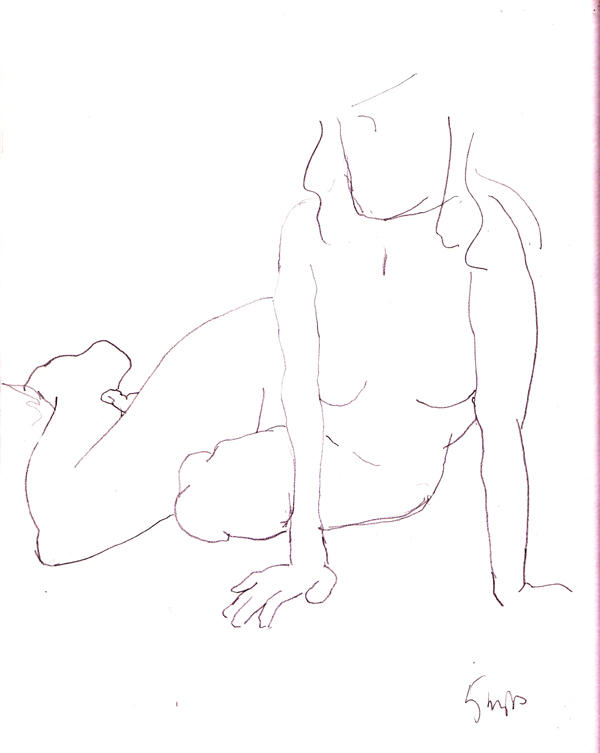
Life Drawing 9th April 2012
Today was a roller-coaster ride between despair and optimism regarding my drawing abilities. I arrived early but wet from the rain and started well, with a nice five minute line drawing of the first pose.
Then, after a couple more poses, I struggled with a reclining pose. At first I tried to draw the whole body, but gave up halfway through and focused on the face which - from this angle - posed quite a challenge. I was pleased with how it came out.
Then there was a half hour standing pose. I stared at it and thought "there's nothing there I want to draw" which is a discouraging start. Since I'd just done so well drawing a face, I decided to concentrate on the face again, but quickly abandoned it as a bad idea.
So then I did a drawing of the upper body, and was thoroughly disheartened by the experience. A more bland drawing, you could hardly wish to see.
Then, after the break, was the fifty minute pose. I had no idea what to expect from myself, so I was quite relieved when it came out as well as it did.
Then, after a couple more poses, I struggled with a reclining pose. At first I tried to draw the whole body, but gave up halfway through and focused on the face which - from this angle - posed quite a challenge. I was pleased with how it came out.
Then there was a half hour standing pose. I stared at it and thought "there's nothing there I want to draw" which is a discouraging start. Since I'd just done so well drawing a face, I decided to concentrate on the face again, but quickly abandoned it as a bad idea.
So then I did a drawing of the upper body, and was thoroughly disheartened by the experience. A more bland drawing, you could hardly wish to see.
Then, after the break, was the fifty minute pose. I had no idea what to expect from myself, so I was quite relieved when it came out as well as it did.
Tuesday, 3 April 2012
Moving houses
In the 1800s it was common for buildings in the United States to be physically moved and placed somewhere else, either for aesthetic reasons, or to create a vacant lot where a larger building could be constructed. Perhaps the most remarkable example was the moving of the Hotel Pelham in Boston in 1869.
This seven storey building had to be moved to allow a road-widening scheme to take place. The New York Times described the method:
"The entire basement has been laid bare, the foundations slightly raised, and large numbers of small iron rollers inserted under them, and these rollers will move upon a stout foundation wall with straps of iron bound to its top."
The force used to move the building itself was by human-operated iron screws (72 of them) pushing the building one inch every five minutes. The whole process took three months to complete. During this process, the hotel and residents continued their business as normal, and utilities such as water and gas were connected to the moving hotel by flexible tubes.
In the end, however, the road-widening scheme itself was to bring about the end of the hotel. Since street cars were more frequent, people preferred to commute into the city from the more affordable suburbs. Also, the nearby Boston Public Library was moved to another part of the city and businesses stopped setting up in the area. Finally, in 1916, the building was demolished and replaced by offices.
References:
"The Moving of a Freestone Hotel in Boston", New York Times, August 23rd 1869
Peter Paravalos, "Moving a House With Preservation in Mind", Rowman Altamira, 2006
Sample chapter here: http://chapters.altamirapress.com/07/591/0759109567ch2.pdf
This seven storey building had to be moved to allow a road-widening scheme to take place. The New York Times described the method:
"The entire basement has been laid bare, the foundations slightly raised, and large numbers of small iron rollers inserted under them, and these rollers will move upon a stout foundation wall with straps of iron bound to its top."
The force used to move the building itself was by human-operated iron screws (72 of them) pushing the building one inch every five minutes. The whole process took three months to complete. During this process, the hotel and residents continued their business as normal, and utilities such as water and gas were connected to the moving hotel by flexible tubes.
In the end, however, the road-widening scheme itself was to bring about the end of the hotel. Since street cars were more frequent, people preferred to commute into the city from the more affordable suburbs. Also, the nearby Boston Public Library was moved to another part of the city and businesses stopped setting up in the area. Finally, in 1916, the building was demolished and replaced by offices.
References:
"The Moving of a Freestone Hotel in Boston", New York Times, August 23rd 1869
Peter Paravalos, "Moving a House With Preservation in Mind", Rowman Altamira, 2006
Sample chapter here: http://chapters.altamirapress.com/07/591/0759109567ch2.pdf
Sunday, 25 March 2012
Professor Todd and the signals from Mars
The astronomer, Professor David Peck Todd (1855-1939), will probably go down in history as the husband of Mabel Loomis Todd, the mistress of Emily Dickinson's brother and eventual editor of Emily's poetry.
He is also notable for dreaming up ambitious schemes regarding astronomy, that became increasingly eccentric as he got older, and he spent his last 17 years in a series of hospitals and nursing homes during which time he became worried that the sun would split in two, or he spent his time working on his plan for eternal life called “Vital Engineering”.
But as a man whose dreams far outweigh his capabilities, I have quite a lot of sympathy with David Todd. Not so much with the whole open marriage thing, nor with the way he kept track of his masturbating habits in his diaries. More to do with his ideas of detecting radio signals from Mars.
His plan, as reported in the New York Times, May 2, 1909, was to ascend to the highest possible altitude that a man could go in a balloon, with some radio equipment in order to hear any radio signals from Mars at a time when it was at its closest. At this time, the debate of life on Mars was still raging since, in 1905, Lowell had published his first photographs of the famous canals of Mars and then in 1907 Alfred Russell Wallace's book “Is Mars Habitable” which debunked the arguments for Martian life was released.
I can find no report about Professor Todd actually achieving his balloon flight (a book “Transmitting the Past” mentions that Todd did not achieve the desired altitude, but gives no reference for this), but it seems that the idea never left him, and he must've been encouraged in May 1910 when balloons were used to observe Halley's Comet.
In the April 15, 1920 issue of the New York Times there is a story concerning Todd's planning finally being carried out in the forthcoming week, after “five years of planning”. I can find no further mention of Todd's flight, but by now his ideas had clearly caught some people's imagination since at least one other attempt to hear signals from Mars (albeit without a balloon) was reported that year, although the debate about intelligent life on Mars had been dismissed by now in astronomical circles. Furthermore, in 1919 Marconi had suggested that some unfamiliar signals he'd received were possibly coming from another world until three years later when he discovered they were coming from the General Electric Company in Schenectady.
The attempt in 1920 by Drs Milliner and Gainer found no signals, but in 1924 another attempt recorded a “face” signal at half-hour intervals. Professor Todd, who was by now in a nursing home and had been for two years, said
“Three years ago Marconi was reported as saying he had heard signals from Mars. A few days ago he was quoted as saying he was too busy to listen to possible messages from Mars and that it was a ridiculous idea to do so. He changed his mind, and no one knows what he heard the first time. With our photograph, however, it is not a question of what one man heard. It is a permanent record, which all can study.”
However, the wavelength chosen was a frequency that would probably be blocked by the Earth's ionosphere so it can't have come from outer space and the “face” picture just looks like some dots to me.
References:
“The Vigil on the Continent,” The London Times, 20th May, 1910
“No Messages from Mars”, The London Times, 24th April, 1920
Alfred Russell Wallace, “Is Mars Habitable”, MacMillan and Co., London, 1907
http://archive.org/details/cu31924012312017
“Weird “Radio Signal” Film Deepens Mystery of Mars,” Washington Post, 27th August, 1924, from http://www.shorpy.com/node/12482
Longsworth, P., “Austin and Mabel: the Amherst affair & love letters of Austin Dickinson and Mabel Loomis Todd,” Farrar, Straus & Giroux, 1984
“From Schenectady not Mars”, Literary Digest, August 5th 1922
He is also notable for dreaming up ambitious schemes regarding astronomy, that became increasingly eccentric as he got older, and he spent his last 17 years in a series of hospitals and nursing homes during which time he became worried that the sun would split in two, or he spent his time working on his plan for eternal life called “Vital Engineering”.
But as a man whose dreams far outweigh his capabilities, I have quite a lot of sympathy with David Todd. Not so much with the whole open marriage thing, nor with the way he kept track of his masturbating habits in his diaries. More to do with his ideas of detecting radio signals from Mars.
His plan, as reported in the New York Times, May 2, 1909, was to ascend to the highest possible altitude that a man could go in a balloon, with some radio equipment in order to hear any radio signals from Mars at a time when it was at its closest. At this time, the debate of life on Mars was still raging since, in 1905, Lowell had published his first photographs of the famous canals of Mars and then in 1907 Alfred Russell Wallace's book “Is Mars Habitable” which debunked the arguments for Martian life was released.
I can find no report about Professor Todd actually achieving his balloon flight (a book “Transmitting the Past” mentions that Todd did not achieve the desired altitude, but gives no reference for this), but it seems that the idea never left him, and he must've been encouraged in May 1910 when balloons were used to observe Halley's Comet.
In the April 15, 1920 issue of the New York Times there is a story concerning Todd's planning finally being carried out in the forthcoming week, after “five years of planning”. I can find no further mention of Todd's flight, but by now his ideas had clearly caught some people's imagination since at least one other attempt to hear signals from Mars (albeit without a balloon) was reported that year, although the debate about intelligent life on Mars had been dismissed by now in astronomical circles. Furthermore, in 1919 Marconi had suggested that some unfamiliar signals he'd received were possibly coming from another world until three years later when he discovered they were coming from the General Electric Company in Schenectady.
The attempt in 1920 by Drs Milliner and Gainer found no signals, but in 1924 another attempt recorded a “face” signal at half-hour intervals. Professor Todd, who was by now in a nursing home and had been for two years, said
“Three years ago Marconi was reported as saying he had heard signals from Mars. A few days ago he was quoted as saying he was too busy to listen to possible messages from Mars and that it was a ridiculous idea to do so. He changed his mind, and no one knows what he heard the first time. With our photograph, however, it is not a question of what one man heard. It is a permanent record, which all can study.”
However, the wavelength chosen was a frequency that would probably be blocked by the Earth's ionosphere so it can't have come from outer space and the “face” picture just looks like some dots to me.
References:
“The Vigil on the Continent,” The London Times, 20th May, 1910
“No Messages from Mars”, The London Times, 24th April, 1920
Alfred Russell Wallace, “Is Mars Habitable”, MacMillan and Co., London, 1907
http://archive.org/details/cu31924012312017
“Weird “Radio Signal” Film Deepens Mystery of Mars,” Washington Post, 27th August, 1924, from http://www.shorpy.com/node/12482
Longsworth, P., “Austin and Mabel: the Amherst affair & love letters of Austin Dickinson and Mabel Loomis Todd,” Farrar, Straus & Giroux, 1984
“From Schenectady not Mars”, Literary Digest, August 5th 1922
Subscribe to:
Posts (Atom)